
Planned Giving
Join the Northern Lights Society by making a planned gift to COA
Planned gifts, often referred to as legacy gifts, represent a donor’s intention to contribute a gift to an organization beyond their lifetime. This is often a continuation of the donations an individual or couple has made while living, but on a much larger scale. Unlike an annual gift, a planned gift is scheduled for the future—often as part of financial or estate plans. These gifts include bequests, charitable gift annuities, and gifts of life insurance, to name a few.
All Northern Lights Society members are invited to an annual gathering with the COA president and special guests, and are recognized in the Philanthropy Report and online.
Ways to make a planned gift
Bequests are one of the simplest, most impactful, and most popular ways to make a planned gift. A bequest in your will lets you pass any specified amount to College of the Atlantic, free of estate tax. You can give cash in a dollar amount, a percentage of your estate, or tangible personal property, all with or without restrictions.
For example, if you make annual gifts to COA and would like to continue your support after your lifetime, you can set up an endowment through your will. This ensures your gift continues to help support students, faculty, and the college for generations.
If you’re planning to make COA one of your beneficiaries through a bequest, please let us know. We will ensure your gift can be used as intended, so that you receive the greatest possible satisfaction from your gift.
Bequests can designate a specific dollar amount, a particular asset, or a fixed percentage of your estate to COA: “I give, devise, and bequeath to College of the Atlantic in Bar Harbor, Maine the sum of $$$ (or a description of the specific asset), for the benefit of College of the Atlantic and its general purposes.”
Specific bequests are made when property is bequeathed for a designated purpose—instruments bequeathed for use in music education, for instance: “I give, devise, and bequeath to College of the Atlantic in Bar Harbor, Maine, the sum of $$$ (or a description of a specific asset), to be used for the following purpose (state the purpose).”
If at any time in the judgment of the trustees of College of the Atlantic it is impossible or impractical to carry out exactly the designated purpose, they shall determine an alternative purpose closest to the designated purpose.
Residuary bequests are made when you leave all or part of the residue of your assets after other terms of the will have been satisfied. “All the rest, residue, and remainder of my estate, both real and personal, I give to College of the Atlantic in Bar Harbor, Maine for its general purposes.”
You can name COA as a beneficiary of an insurance policy, retirement fund, or donor-advised fund.
Through annuities and trusts you can receive income for life—while creating a legacy that will help COA and our students for generations to come. This document introduces three life-income gift options and how they can align with your financial planning and philanthropic intentions.
College of the Atlantic recommends that you seek the counsel of an attorney who specializes in estate planning to design a gift that benefits the people and organizations you care about most. The COA Advancement Office can work with your advisors to help you plan for tomorrow and receive maximum benefits today.
For more information, please fill out this form. We can discuss your philanthropic aims, and together we can find the perfect choice for you and your family.
Questions?
Contact Lynn Boulger, Vice President for Institutional Advancement, at lboulger@coa.edu or 207-801-5620 or fill out this form.
Hear from Northern lights society members

Kelly Dickson MPhil ’97
I feel it is important to give during your lifetime and to leave something behind for later as well to ensure this institution is here for the next generation.
I loved my time at COA. I came here for the MPhil program and studied Resource Sensitive Tourism in cooperation with Friends of Acadia and Acadia National Park. I was challenged mentally and loved the spirit of the place. One of the things that really stood out for me was how students are encouraged to perceive all sides of an issue — choices are not black or white but many shades of gray — and various outcomes might be had from each. Which choices are the best for the people of this community vs the economy vs the environment? I feel like a good liberal arts education will broaden your perspective. COA achieves this in spades through its holistic, human-ecological lens.
Like many students, I received financial aid while attending COA. After graduation, I decided that I wanted to pay it all back if I could manage it. I have served in volunteer leadership roles at the college and I joined the Alumni Leadership Circle and the Northern Lights Society. I feel it is important to give during your lifetime and to leave something behind for later as well to ensure this institution is here for the next generation.
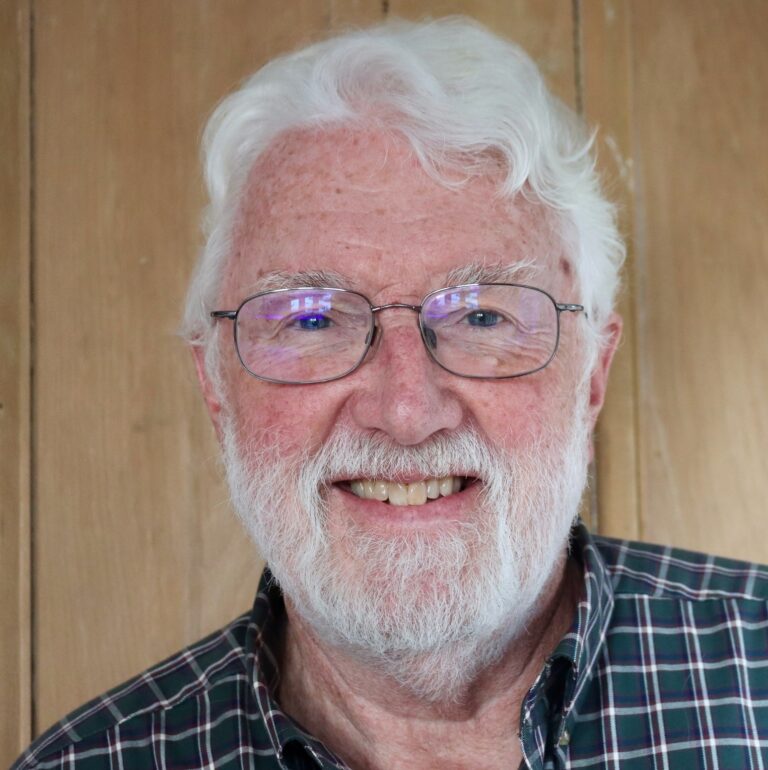
Ron Beard
Including COA in my will aligns with the values I try to live day to day. I intend my small contribution to flow with the contribution of others, helping these experiments continue.
In the early 1970’s Ron Beard invited founding COA President Ed Kaelber to speak at UMaine, and invited Ed and his wife to dinner with President Win Libby and his wife. Ron served spaghetti!
Over the decades, Ron has been an integral part of the COA community, leading Outdoor Orientation Program (OOPs) trips on the Allagash river with Ted Kauffman for 30 years, teaching a wide range of community development courses, and serving as a COA trustee for the past 20 years, much of that as the secretary of the board. And it has been a family affair as Ron’s daughter Alana, whose mom is former registrar Judy Allen, graduated from COA in 2003.
“It is rare and satisfying to be able to engage with the good people of a good institution over most of a lifetime. So many different ways to be involved, so many meaningful relationships, supporting so many experiments in how humans engage meaningfully with the world around them. I have also watched the vision of the founders—Les Brewer, Father Jim Gower, and Ed Kaelber—become reality, with COA contributing in significant ways to the community life and the economy of Mount Desert Island and the surrounding area.”
“Including COA in my will aligns with the values I try to live day to day. I intend my small contribution to flow with the contribution of others, helping these experiments continue.”
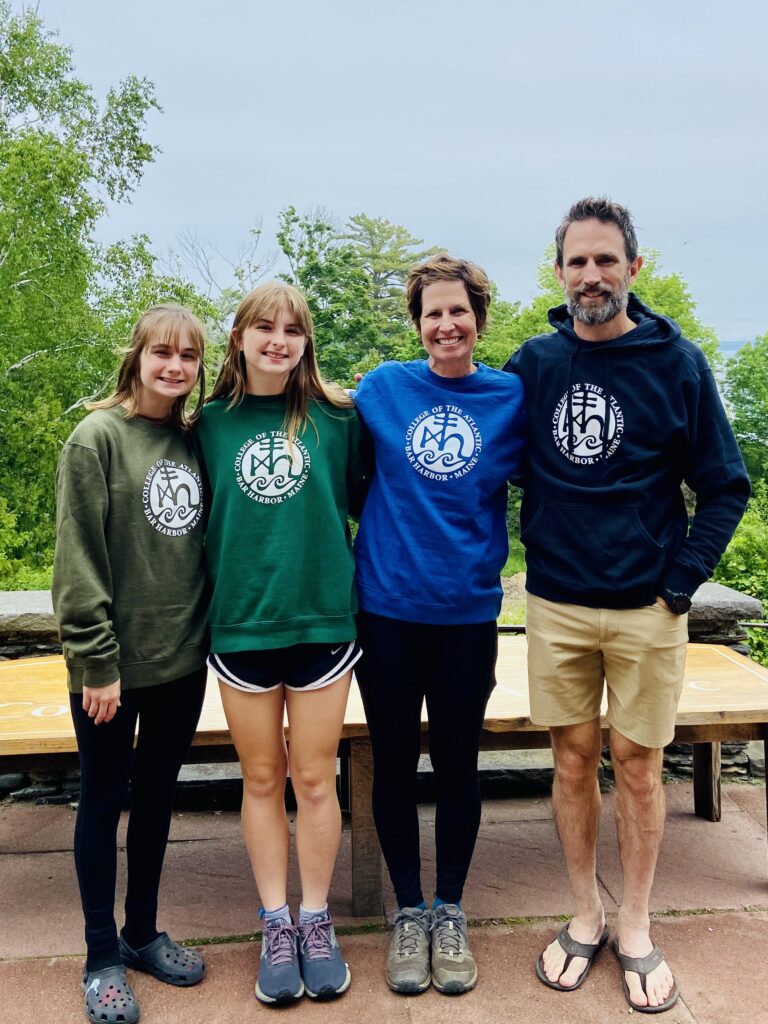
Elizabeth Rousek Ayers ’95
It makes you think, what can I do now and what can I potentially leave behind? It doesn’t have to be a grand amount—whether it’s $1,000 or $10,000, it shows you believe in COA.
A self-professed army brat, Elizabeth Rousek Ayers ’95 moved around a lot as a child, in both the United States and Germany. As a result, she craved stability.
“I wanted to be a part of something, and I found that sense of community at College of the Atlantic,” she says. “I loved my OOPS trip—a sea kayaking trip led by Ander Thebaud and Dianne Clendaniel. I loved the food at Take-A-Break and Bar Harbor in the winter—the walks back and forth to campus, walking my dog in the park, and feeling safe and comfortable all the time.”
Elizabeth recently named COA in her will. “COA is such a piece of my heart and soul, and I believe in the mission wholeheartedly,” she says. She and her husband Matt Ayers asked a friend of theirs who practices law to draft their will. “I feel like creating a will is a good opportunity to reflect on your priorities. My dad died unexpectedly when he was 50. Life can be so short. It makes you think, what can I do now and what can I potentially leave behind? It doesn’t have to be a grand amount—whether it’s $1,000 or $10,000, it shows you believe in COA.”
Elizabeth says she takes the interconnectedness of human ecology with her in everything she does now. “It can be an inconvenient world when everything isn’t black and white—but this is the completely messy, interesting world that I discovered at COA.”
Elizabeth studied alternative agriculture and botany at COA, which prepared her to work with the Royal Horticultural Society in England and for private estates in Maine, Connecticut, and Pennsylvania. She earned a master’s degree at the Conway School of Landscape Design in 2001, but didn’t want to spend her life “drawing circles and figuring out parking for people,” so she continued her career as an estate gardener with the additional skill set of design. This allows her to keep her hands dirty and offers the flexibility of working part time so she can spend more time with her family.
Good news for COA: both of her daughters, Ava (16) and Lucy (13), are considering attending the college. “I appreciated the opportunity I had at COA, so I want to get them there,” she says.
Elizabeth visits campus every other year and appreciates the new dorms and classroom space. She stays in touch with former classmates, enjoys receiving COA’s alumni newsletter, The Peregrine, and follows COA on social media. “It’s hard to be competitive in education, but I feel that COA has risen to the challenge of staying relevant.”

Henry L.P. “Hank” Schmelzer
There is a simple reason we have included COA in our wills: COA is an incredible college! COA students, faculty, and staff are dedicated to making human ecology the
key to a better world.
There is a simple reason we have included COA in our wills: COA is an incredible
college! COA students, faculty, and staff are dedicated to making human ecology the
key to a better world. It strives to be the best and the most innovative in creating
academic programs which are responsive to the world’s needs. That’s how it has
repeatedly earned the ranking of the Number One Green College in The Princeton
Review. That’s why its whale research is recognized around the world. That’s why it has
such a diverse international student enrollment. We believe in COA’s vision and
values. We have lived on Mount Desert Island for over 25 years, and COA has been a source
intellectual inspiration and community enrichment. We count among our best friends
those we’ve met through COA, including the international students for whom we’ve
been a host family. By making a testimonial gift to the College, we can support COA’s
long-time goal to be “life changing, world changing”.