
Field Ecology & Natural History
College of the Atlantic
The Gulf of Maine is our front yard
Acadia National Park is our back yard. We have two off-shore field stations, a research vessel, and seemingly endless habitat in which to explore and learn.
Nature lives out there—not in the laboratory or library. So in all biology classes we emphasize the importance of understanding the organism in its natural environment and the role humans have played in shaping that environment. We get students in the field as soon as possible, often in their first term in classes such as Ecology/Natural History, Marine Biology, or The Geology of MDI.
All of the biologists on the COA faculty focus on biology of “intact” organisms in their natural environments—a rarity in this age of genetics and molecules. We do, of course, teach genetics and other cellular and molecular biology classes, but we never lose sight of the centrality of organisms and their environments. COA biology faculty emphasize natural history and field ecology throughout the biology curriculum.
Natural history is the deliberate observation of plants and animals in their environment. Field ecology is grounded in Natural history, but goes beyond observation, seeking to test hypothesis, often via experiments in the field.


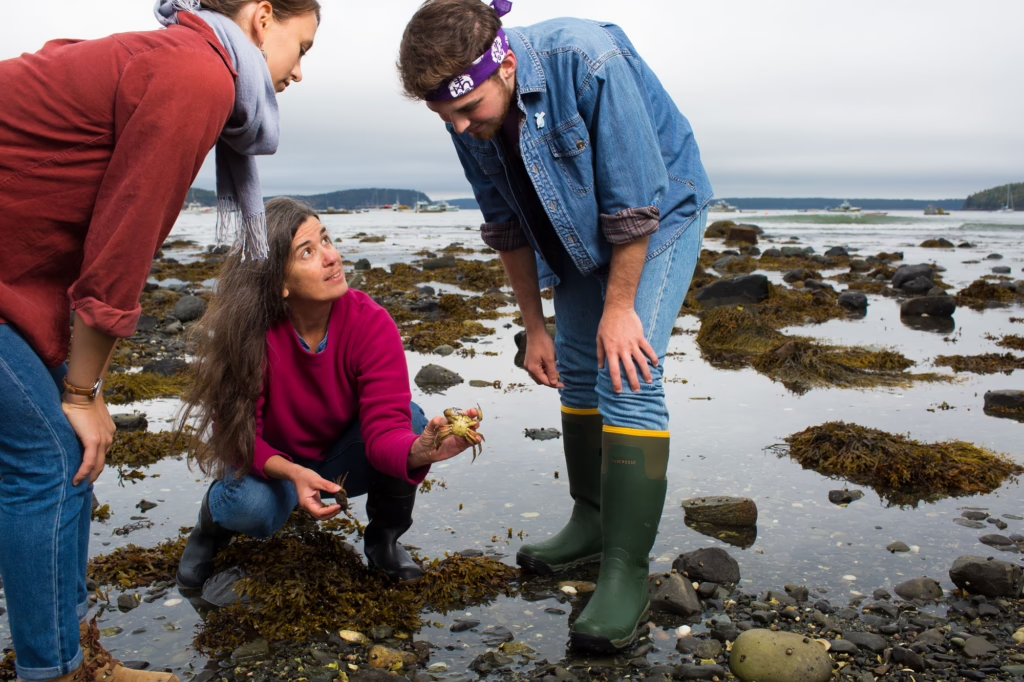
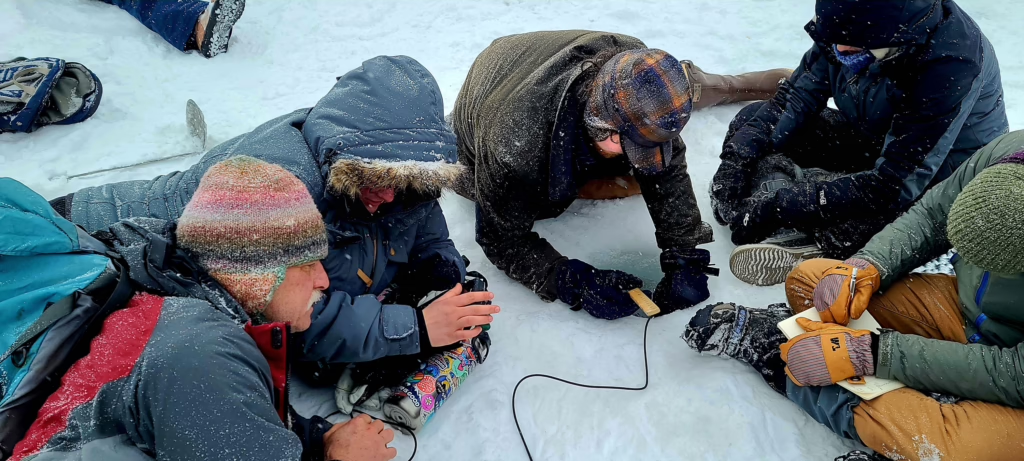

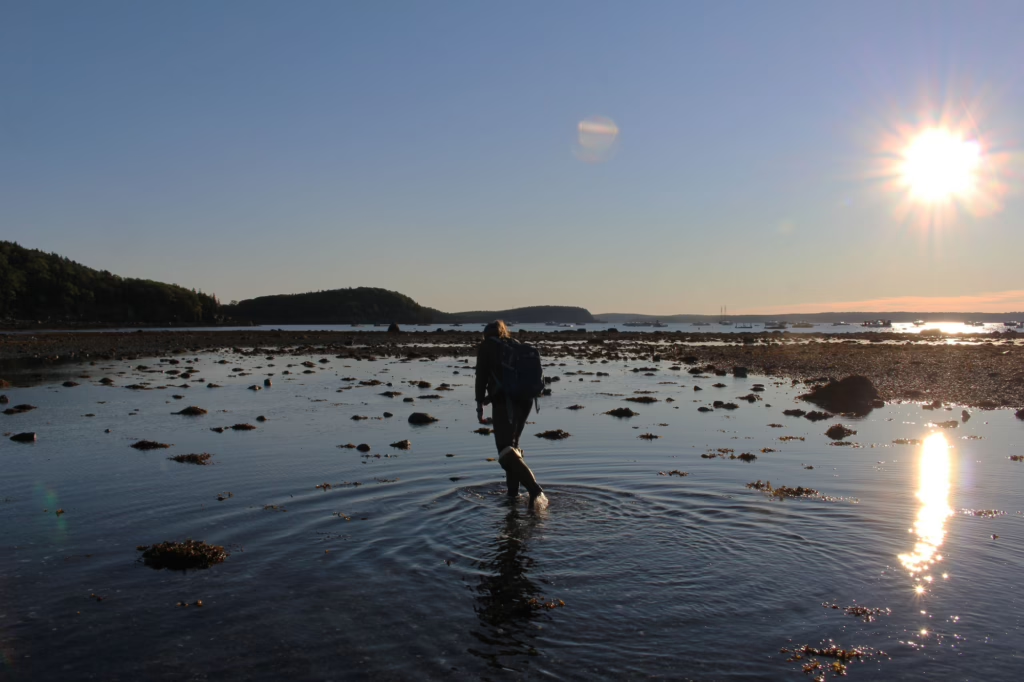

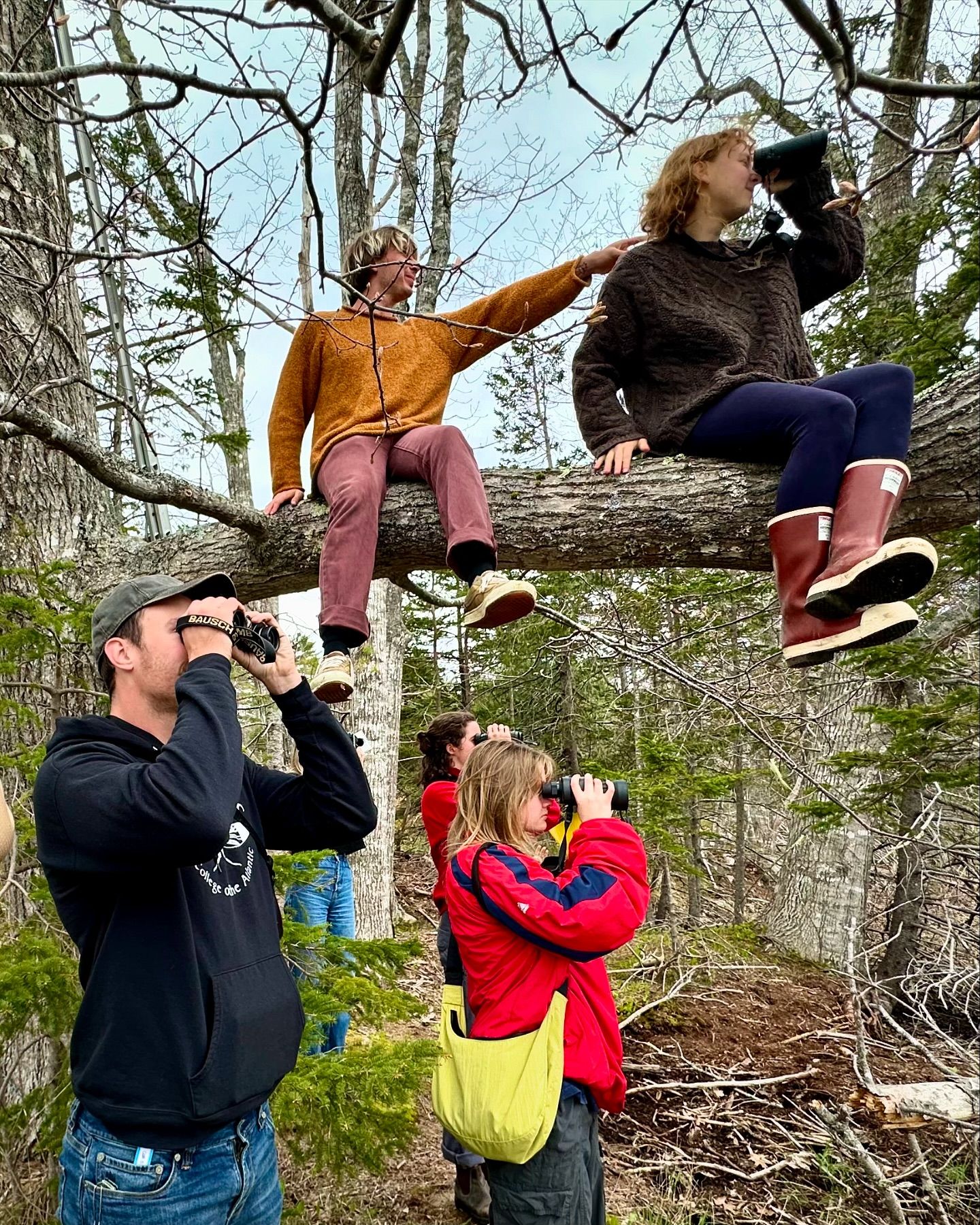


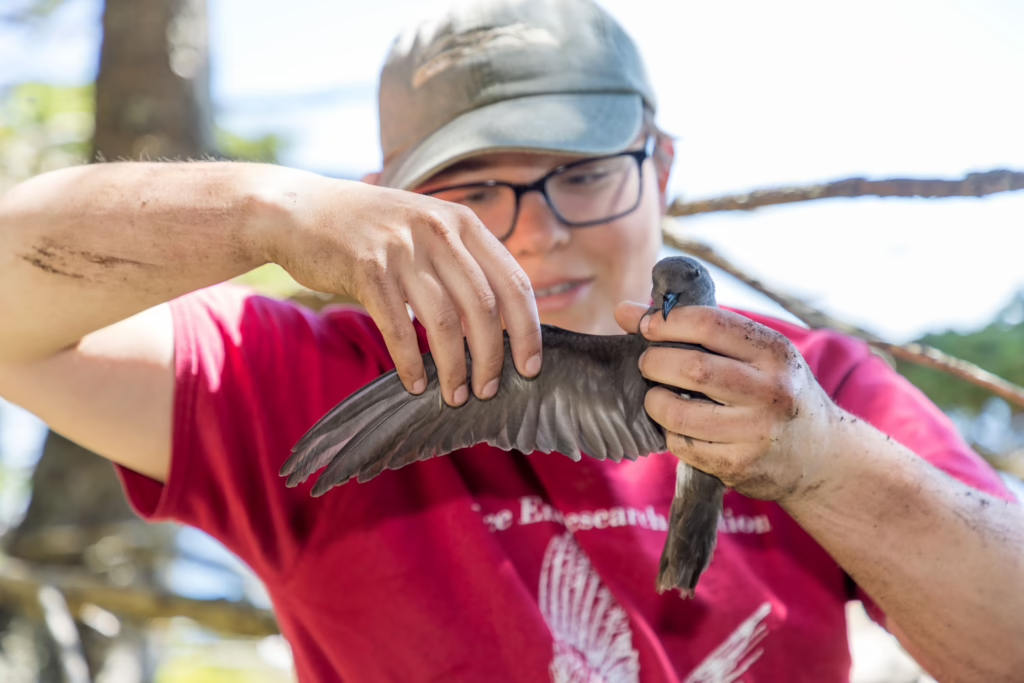


What are habitats? Can nature be in balance?
While we emphasize the importance of environment and habitat, it is important to recognize that habitats can be complex and subtle. The boundaries between habitats are porous, if such boundaries can be said to exist at all. Furthermore, the notion of, say, typical grassland, is a much like typical college student—both are stereotypes and generalizations that obscure variety and variation. We resist the tendency to see nature as good, harmonious, or in balance. As often as not we see a world that is dynamic and variable, constantly in flux.
If you choose to study Field Ecology and Natural History at COA you will spend lots time in the field as well as in the classroom and lab. You will learn about the habits and life histories of species in Maine and elsewhere. Along the way, expect to have your notions about nature and natural communities challenged and complexified. You will come to experience the natural world as a dynamic and evolving set of species and environments.
Reminder: Areas of study at COA aren’t majors or formal concentrations. All COA students design their own major in human ecology and are free to chart their own path. Your major is defined by you, not us.
With faculty mentors, COA students come up with their own research questions, write grant proposals, and present their results at meetings of national and international scientific societies.
Faculty

John G.T. Anderson
ABOUT
Before COA
My mother was a scientist, my father was a historian. Both loved birds, wildflowers, and the out-of-doors. I was raised as a Human Ecologist long before i ever heard the term. I am a New Zealander by nationality, British by upbringing, and have spent time in the UK, Europe, and the American West. I am fascinated by ideas of Wilderness, Wildness, Aesthetics, and our belief in the Holy. I find much of the post-1914 world in extremely bad taste, and deeply resent having missed Charles Darwin by less than a century.
May 1986 to August 1987: Research Assistant, University of Rhode Island Environmental Data Center.
Course Areas
Zoology, anatomy, ecology, pre-med/pre-vet studies, behavior
COURSES
More Information about my Courses
I believe strongly in the mixture of “hands on” and theoretical work, and if I were to lean one way, it would be towards that magical place that we call “The Field”, as in Field Trips, Field Studies, Field Work. many of the mistakes in modern Ecology, Conservation, Public Policy, etc. have come from relying overly much on theory without regard for facts on the ground. To this end, Ken Cline and I teach Great West, an 8 week immersion in traveling through the Western states, listening to people Not Like Us in places Not Like Maine. Offsetting this, in Summers I take students to Great Duck to listen to species Not Like Us and immerse ourselves in this land that we come to call home. I have a deep and abiding interest in both History and Geography, and all my classes are informed by both -sometimes to the annoyance of my students! At the same time I think it critically important if we are to be in truth “Life Changing/World Changing” (silly motto) we need to know When and Where and Who. Then maybe we can talk about What and Why. I also have a deep and abiding love of poetry & that works its way into most of my classes also.
EDUCATION
- B.A. University of California, Berkeley, 1979
- M.A. Ecology and Systematic Biology, San Francisco State University, 1982
- Ph.D. Biological Sciences, University of Rhode Island, 1987
HONORS & AWARDS
INTERESTS
The current focus of my research is on colonial nesting seabirds and island ecology. I am also interested in the application of G.I.S.and remote-sensing technology to landscape ecology and conservation.
At present, my field research centers around Great Duck Island in eastern Maine. This island supports one of the largest colonies of Leach’s Storm Petrels in the continental United States, it may also be the largest breeding colony of Black Guillemots in the Lower 48. My students and I are looking at habitat utilization by Herring and Black-backed Gulls, Guillemots, and Petrels. In addition, we are examining territoriality and foraging behaviors by gulls and chick survival/mortality in relation to parental investment.We are also examining the impact of bald Eagles and other predators on colonial nesting seabirds.
Working in collaboration with Acadia National Park we have examined the effects of rising sea-level on nesting islands. We also investigate the impact of introduced and native herbivores on island vegetation, and the impact of vegetation change on nesting habitat.
In addition to work at Great Duck I am interested in the intersection between Natural History and Human History, in relation to long-term ecological processes.
ADVOCACY
Co-Archivist for the Waterbird Society
Councillor for Waterbird Society
past President of the Society for Human Ecology
1990-1996 Commission Member, State of Maine Governor’s Commission on Oil Spill Preparedness
PUBLICATIONS
Anderson, J.G.T. K. R. Shlepr, A.L. Bond, and R.A. Ronconi. 2016. A Historical Perspective on Trends in Some Gulls in Eastern North America, with Reference to Other Regions. Waterbirds 29(sp1):1-9.
Anderson, J. 2015. The potential impact of sea level rise on seabird nesting islands in Acadia National Park. Natural Resource Report NPS/ACAD/NRR—2015/1055. National Park Service, Fort Collins, Colorado.
Anderson, J.G.T. 2014. Forms most beautiful and most wonderful. GNSI Journal of Natural Science Illustration – 2014 no.2:1-5.
Tewksbury, J. J.G.T. Anderson, R.E. Ley and C. Martinez del Rio et al.. 2014. Natural History’s place in science and society. BioScience 64 (4):300-310
Anderson, J. G. T. and K Anderson. 2005. An analysis of band returns of the American White Pelican, 1922 to. 1981. Waterbirds 28:55-60.
Szewczyk, R. J. Polastre, A. Mainwaring, J. Anderson, and D. Culler. 2004. An Analysis of a Large Scale Habitat Monitoring Application. Pp. 214-226 Proc. Second ACM Conference on Embedded Networked Sensor Systems
Polastre, J. R. Szewczyk, A. Mainwaring, D. Culler, J. Anderson 2004. Analysis of wireless sensor networks for habitat monitoring p.329-423 Ci S. Raghavendra, K M. Sivalingam, and T. Znati (eds.) Wireless sensor Networks. Springer Science Media. New York.
Anderson, J.G.T. and C.M. Devlin . 1999. Restoration of a multi-species seabird colony. Biol. Conservation 90:175-181
Anderson, J.G.T. 1992. Management and long-term monitoring of a mixed-species tern colony. Dev. in Landscape Management and Urban Planning 7:261-265. Elsevier, Amsterdam.
Anderson, J.G.T. 1991. Foraging Behavior of the American White Pelican in western Nevada. Col. Waterbirds 14:166-172.
Anderson, J.G.T. and J.K. Anderson. 1975. A lost city rediscovered? Calif. Publications in Classical Antiquity Univ. of Calif Press.
Mancinelli, I. K. Cline, and J.G.T. Anderson. 1993. Computer assisted community planning and decision-making. pp 330-335 in S.D. Wright, T. Dietz, R. Borden, G. Young, and G. Guagnano eds. Human Ecology: Crossing Boundaries. Soc. Hum. Eco. Ft. Collins, Colorado.
Anderson, J.G.T. R.J. Borden, I. Mancinelli, and K. Cline. (1994). Applied Human Ecology: College-community cooperation through computer-assisted regional planning and decision making. In H. Ernste (ed.) Pathways to Human Ecology/Wege zur Humanökologie Springer Verlag.
Borden, R. and J.G.T. Anderson (1994) Computer assisted regional planning and decision-making: GIS as a tool for collaboration. Sustainable Development: Challenges for the future Proc. IV World Academic Conference on Human Ecology. Merida, Mexico.
August, P.V., S.A. Avazian, and J.G.T. Anderson. 1989. Evidence for use of magnetodetection by homing field mice. J. Mammalogy 70:1-9.
August, P.V. and J.G.T. Anderson. 1987. Mammal sounds and motivational/structural rules: a test of the hypothesis. J. Mammalogy 68:1-9.
Heppner, F. and J.G.T.Anderson. 1985. Leg thrust important in takeoff of domestic pigeon. J. Exp. Biol. 114, 285-288.
Heppner, F., J.L. Convissar, D.E. Moonan, and J.G.T. Anderson. 1985. Visual angle and formation flight Canada Geese (Branta canadensis). Auk 102, 195-198.
Heppner, F.H., J.G.T. Anderson, A.E. Farstrup, and N.H. Weiderman. 1985. Reading performance on a standardized test is better from print than from computer display. J. Reading. Jan. 1985, 321-325.
Books and Book Chapters
Anderson, J.G.T. A. L. Bond, K. R. Shlepr and R. A. Ronconi (eds) 2015. Gulls in Two Worlds: the decline of Herring and Great Black-backed Gulls in the Western North Atlantic. Special Edition, Waterbirds.
Anderson, J.G.T. 2012 Deep Things Out of Darkness: A History of Natural History. (Univ. of Calif. Press)
Anderson J.G.T. 2011 Sauntering Towards Bethlehem. Chapter 5 in The Way of Natural History. T. Fleischner (ed.) Trinity Univ. Press.
Drury, W.H. 1998. Chance and Change: Ecology for Conservationists. (J.G.T. Anderson ed.) Univ. of California Press.
Sarah R. Hall
ABOUT
Before COA
Sarah joined the faculty of COA in the Fall of 2012 and teaches courses in the Earth Sciences. Before coming to COA Sarah was an Assistant Professor at McGill University in Montreal following her graduate work at the University of California, Santa Cruz and undergraduate degree at Hamilton College. She grew up in upstate NY and after college spent a few years in Atlanta, GA working as a Geologist at an environmental consulting firm and as an ECOWATCH AmeriCorps team member.
Course Areas
Earth science, geology, geomorphology, weather, climate, water, landscape, climate change
Personal Website
COURSES
More Information about my Courses
Sarah regularly offer courses on topics exploring landscape shaping processes, climate, geologic principles, interactions between human and Earth systems, as well as place-based studies of Mt Desert Island (MDI) and Maine.
Most of her courses have some field component where COA students may be learning field methods (e.g. mapping, water sampling, measuring the orientation of geologic features, or describing soils), while visiting parts of Acadia National Park, MDI, or Maine to understand the overall geologic history of the region. In some classes, students design and complete self-guided field work as in the Climate and Weather class where students produce a field guide to various meteorological phenomena. Occasionally, Sarah offers intensive field courses to regions with very different geology from Maine such as Eastern California and the Peruvian Andes.
Sarah regularly advises students on independent research projects. Some are related to her ongoing research and some are inspired by student interest. See some examples of student research here. Explore student created Story Maps of select National Parks here.
Opportunistically Sarah co-teaches courses with other faculty, such as The Anthropocene, Demons from the Depths, and Topics in Research: Geoscience and Geochemistry offering students an inter- multi- or transdisciplinary learning experience.
For the 2023-2024 academic year, geoscience courses were taught by glacial geomorphologist, Scott Braddock while Sarah pursued an AAAS Science and Technology Policy Fellowship in Washington D.C. Sarah is currently positioned in the Landslide Hazards Program Office, Natural Hazards Mission Area of the U.S. Geological Survey.
EDUCATION
- Ph.D. Earth and Planetary Sciences, University of California, Santa Cruz, 2009
- B.A. Geology, Hamilton College, 2001
INTERESTS
Sarah is trained as a geomorphologist studying the processes shaping the surface of the earth. Her research interests are quite broad including mountain building, past glaciations, active faulting, watershed monitoring, and the erosion of landscapes. One of Sarah’s current research projects involves completing a chronology of past glaciations in a portion of the Peruvian Andes. Two local water quality projects are focused on watershed monitoring in and around Acadia National Park and a study concerning private well water characteristics. Through her teaching of field-based courses, Sarah has begun to explore ways to connect professional development opportunities directly to curricular content. With collaborators and COA students, she developed and implemented the Environmental-STEM field-based professional development program, a curriculum that is freely available online for use by other educators.
ADVOCACY
Member of the Executive Council of the Geological Society of Maine.
Cooperating curator of the Hudson Museum at the University of Maine.
Affiliated faculty researcher at the Climate Change Institute.
Steering committee member of the Coastal Maine Geopark.
PUBLICATIONS
Publications
Select publications are listed below. A star (*) indicates student co-author. For a full list, visit this website.
Benavente, C., Palomino, A., Wimpenny, S., García B., Rosell, L., Aguirre, E., Macharé, J., Rodriguez Padilla, A.M.*, and Hall, S.R., 2022. Paleoseismic Evidence of the 1715 C.E Earthquake on the Purgatorio Fault in Southern Peru: Implications for Seismic Hazard in Subduction Zones, Tectonophysics, doi:10.1016/j.tecto.2022.229355
Walker, B., Hall, S.R., and Schmidt, C. 2020. Environmental STEM (E-STEM) Field Course and Professional Development Modules, Reviewed Teaching Activity Collection of the Teach The Earth Program (some “Exemplary” modules), Science Education Resource Center (SERC), Teaching Resources website
Farrell, A., Buckman, K., Hall, S.R., Muñoz, I.*, Bieluch, K., Zoellich, B., and Disney, J., 2021. Adaptations to a secondary school-based citizen science project to engage students in monitoring well water for arsenic during the Covid-19 pandemic. Journal of STEM Outreach 4(2), doi: 10.15695/jstem/v4i2.05.
Saillard, M., Audin, L., Rousset, B., Avouac, J.-P., Chlieh, M., Hall S.R., Husson L., Farber, D.L., 2017. From the seismic cycle to long-term deformation: linking seismic coupling and Quaternary coastal geomorphology along the Andean Megathrust, Tectonics, 36(2), p. 241-256. doi: 10.1002/2016TC004156.
Michalak, M.K., Hall, S.R., Farber, D.L., Audin, L., and Hourigan, J.K., 2015. (U-Th)/He Thermochronology records late Miocene accelerated cooling in the north-central Peruvian Andes, Lithosphere, 8(2), p.103–115, doi: 10.1130/L485.1.
Margirier, A., Robert X., Audin, L., Gautheron, C., Bernet, M., Hall, S.R., and Simon-Labric, T., 2015. Slab flattening, magmatism, and surface uplift in the Cordillera Occidental (northern Peru), Geology, 43(11), p. 1031-1034, 10.1130/G37061.1.
Hall, S.R., Farber, D. L., Audin, L., Finkel, R.C., 2012. Recent contractile deformation in the forearc of southern Peru, Earth and Planetary Science Letters, 337-338, 85-90, doi: 10.1016/j.epsl.2012.04.007.
Hall, S.R., Farber, D.L., Ramage, J.M., Rodbell, D.T., Finkel, R.C., Smith, J.A., Mark, B.G.,Kassel, C., 2009. Geochronology of LLGM through Holocene glaciations from the tropical Cordillera Huayhuash, Peru, 2009. Quaternary Science Reviews, 28, 2991-3009, doi:10.1016/j.quascirev.2009.08.004.
Saillard, M., Hall S.R., Audin, L., Hérail, G., Farber D.L., Finkel, R.C., Martinod, J., Bondoux, F., and Regard,V., 2008. Pleistocene marine terrace development and non-steady long-term uplift rates along the Andean margin of Chile (31°S). Earth and Planetary Science Letters, 277(1-2), 50-63, doi:10.1016/j.epsl.2008.09.039.
Hall, S.R., Farber, D.L., Audin, L., Finkel, R.C., Meriaux, A-S., 2008. Geochronology of pediment surfaces in southern Peru: Implications for Quaternary deformation of the Andean forearc. Tectonophysics, 459,186-205, doi: 10.1016/j.tecto.2007.11.073.
Presentations
Abstracts (*student author) of select presentations featuring student research. A full list of presentation abstracts are available here and find out more about student presentations.
Capuano, B., Adams, M., Hall, S.R., Disney, J., 2022. Precipitation-mediated fluctuations in well water arsenic in Hancock County, ME, Maine Sustainability and Water Conference, Augusta, Maine, March 31, 2022.
Feher, A.*, Hall, S.R, Disney, J.E., and Jackson, B.P., 2022. Arsenic abundance in arugula and kale, Maine Sustainability and Water Conference, Augusta, Maine, March 31, 2022.
Slamova, L., Hall, S.R., Feher, A., Disney, J.E., and Jackson, B.P., 2022. Do the orchard soils of Mount Desert Island region harbor residuals of historical arsenical pesticide use? Maine Sustainability and Water Conference, Augusta, Maine, March 31, 2022. Won honorable mention for poster presentation.
Moran, L.*, Hall, S.R., Farrell, A., and Disney, J., 2022. Influence of different water treatment systems on arsenic concentrations in private well groundwater: A view from MDI, ME.
Muñoz, I.L., Cahueque, S., Farrell, A., Moroz, G., Hall, S.R., Buckman, K., and Disney, J. 2021. Pathways of arsenic ingestion in Maine: Data to Action, Geological Society of Maine Spring Meeting, virtual meeting poster presentation, April 9, 2021, published in GSM Newsletter July 2021
Moroz, G.*, Hall, S.R., Disney, J., Farrell, A., and Stanton, B., 2021. Spatial, temporal, and well-specific influences on well water quality, northern Mount Desert Island, Maine, Maine Sustainability and Water Conference, virtual meeting poster presentation, April 1, 2021; Won honorable mention for poster presentation.
Hall, S.R., Moroz, G.*, Farrell, A., Disney, J., and Stanton, B., 2021. Spatial and Temporal Patterns of Private Well Water Quality: A View from Mt. Desert Island, Maine, Maine Sustainability and Water Conference, virtual meeting talk, March 31, 2021.
Hall, S.R., Walker, B., Schmidt, C.M., and Paul, J.R., 2019. Use of a field and career preparation program as a tool for recruitment and retention in the Environmental STEM workforce: A report from the ESTEM Program for 2-year and 4-year college undergrads. Geological Society of America Abstracts with Programs. Vol. 51, No. 5, Presented at GSA Oct. 2019 by Walker, B.
Aragon Oreggo, M.F., Moroz, G., Gibson, S., Kumagai, A., Löwgren, S.*, Hall, S.R., Schmidt, C.M., Walker, B., and Paul, J.R., 2019. Matching skill to need: A multi-institution approval to field-based Environmental-STEM (ESTEM) studies and professional development skills, Geological Society of America, Abstracts with Programs, Vol 51, No. 1, 328351. (Also presented at Acadia National Park Science Symposium, 2018)
Farrell, A., Poland, R., Hall, S.R., Disney, J., and Stanton, B., 2019. Monitoring well water for arsenic on Mt. Desert Island: Engaging high school and college students in interdisciplinary and societally relevant work, Geological Society of America, Abstracts with Programs, Vol 51, No. 1, 328363.
Gallardo Garcia Freire, P.*, Henkel, B. and Hall, S.R., 2019. Past, present and future of the College of the Atlantic stream: A small coastal watershed assessment, Geological Society of America, Abstracts with Programs, Vol 51, No. 1, 328441. (Also presented at ANPSS, 2018 and GSM, 2019)
Gibson, S., Lowgren, S., Hall, S. R., and Smith, S. M. C., 2019. Geomorphic map of Kebo Brook Watershed: Identifying characteristic channel geometry and channel head locations for a small post-glacial coastal New England watershed, Geological Society of America, Abstracts with Programs, Vol 51, No. 1, 328398. (Also presented at Geological Society of Maine, 2019 – Best Student Poster Presentation)
Hall, S.R., McKenzie, J.M., Hall, B.L., Meriaux, A.-S., Fortin, M.-A.*, 2019. Glacial geochronology transecting a tropical mountain range, the Cordillera Blanca of northern Peru, Geological Society of America, Abstracts with Programs, Vol 51, No. 1, 328472.
Henkel, B., Hall, S.R., Gallardo Garcia Freire, P., and Löwgren, S., 2019. Watershed monitoring in Acadia National Park: Preliminary results based on three years of data collected across multiple watersheds, Geological Society of America, Abstracts with Programs, Vol 51, No. 1, 328382.
Van Vliet, N. and Hall, S.R., 2019. An anthropologist and a geologist go into a classroom and…, Geological Society of America, Abstracts with Programs, Vol 51, No. 1, 328331.
Rodriguez Padilla, A.M.*, Hall, S.R., Benavente Escobar, C., Venuti, G.L., Fernandez Baca, B.G, Roselle, L.N., and Audin, L., Evolution of a Paradoxical Landscape: New Constraints for Tectonic and Climatic Processes in the Forearc of Southern Peru, 2018. American Geophysical Union Fall Meeting, Washington, D.C., EP53A-06.
Venuti, G.L.*, Hall, S.R., and Nurse, A., The Paleoecology of Great Duck Island, Acadia National Park Science Symposium, College of the Atlantic (Nov, 2017); Geological Society of Maine Meeting, Unity College (April, 2018); Borns Symposium, Climate Change Institute (May 2018).
Taylor, V., Crowley, C., Lowgren S., Gallardo, Garcia, Freire, P., Hall, S.R., and Henkel. B., 2018. Insights into stream water quality: Bacteria sampling at the Cromwell-Kebo Watershed through summer storm events., Acadia National Park Science Symposium, College of the Atlantic, Oct. 20, 2018.
Gray, S.E. III*, Hall, S.R., Michalak, M.J., and Bailey, D.G., A new look at the geologic history of Great Duck Island and Mount Desert Rock through high resolution aerial imagery, geologic mapping, geochemistry, and geochronology, 2017. Society of America Abstracts with Programs. Vol. 49, No. 2, doi: 10.1130/abs/2017NE-291262.
Hall, S.R., Schmidt, C.E., and Walker, R., 2017. Challenges and opportunities in the development of a multiinstitution field-based professional development program for Environmental-STEM (ESTEM) undergraduates, Geological Society of America Abstracts with Programs. Vol. 49, No. 2, doi: 10.1130/abs/2017NE-290986.
Minogue, W.*, Hall, S.R., Henkel, B., Stream discharge moitoring in seven watersheds on Mt. Desert Island, ME, Acadia National Park Science Syposium, Schoodic Educational & Research Center, September 2016.
Hall, S.R., Hodson, K.R., Michalak, M.J., Farber, D.L., Hourigan, J.K., 2016. Pliocene to present denudation in the Cordillera Blanca, Peru: Interactions of climate and tectonics in a tectonically active glaciated mountain range, Geological Society of America Abstracts with Programs. Vol. 48, No. 2, paper no. 15-7
Prest, T., Strader, J., Galey, M.*, Hall, S.R., Assembling a teaching collection at COA: outcrop, hand-sample, and thin-section analysis of rocks from Mt. Desert Island and Mt. Desert Rock. Acadia National Park Science Symposium, Schoodic Educational & Research Center, 2014.
Davis, M.W.*, Hall, S.R., Farber, D.L., Audin, L., Finkel, R.C., 2007. Quaternary geologic history of the Rio Tambo, southern Peru: repeated mass-wasting events in Western Cordillera drainages, Eos Trans. AGU, 88(52), Fall Meet. Suppl., Abstract T31A-0283.

Susan G. Letcher
ABOUT
Before COA
- Assistant Professor of Environmental Studies, Purchase College (SUNY), 2011-2017
- Resident Professor, Organization for Tropical Studies, 2009-2011
- Coordinator, Organization for Tropical Studies Research Experience for Undergraduates at La Selva Biological Station, Puerto Viejo de Sarapiquí, Costa Rica, 2007-2008
Personal Websites
Professional profile – ORCID
Office Hours
Tues 1-2:30 in TAB (drop in) or by appointment
Course Areas
Botany, ecology, statistics
COURSES
EDUCATION
- PhD, Ecology and Evolutionary Biology, University of Connecticut, 2008
- BA, Biology and Music, Carleton College, 2000
HONORS & AWARDS
PUBLICATIONS
M.T. van der Sande, L. Poorter, G. Derroire, M.M. do Espirito Santo, M. Lohbeck, S.C. Müller, R. Bhaskar, M. van Breugel, J.M. Dupuy-Rada, S.M. Durán, C.C. Jakovac, H. Paz, D.M.A. Rozendaal, P. Brancalion, D. Craven, F. Mora Ardilla, J.S. Almeida, P. Balvanera, J. Becknell, B. Finegan, R. Gomes César, J.L. Hernández-Stefanoni, D. Kennard, S.G. Letcher, E. Marín-Spiotta, R. Muñoz, C. Reyes-García, L. Sanaphre-Villanueva, L.P. Utrera, G.W. Fernandes, F.S. Álvarez, J.L. Andrade, F. Arreola, V. Boukili, G.A.L. Cabral, J. Chave, R. Chazdon, G. Colletta, M.D. Magalhães Veloso, B. de Jong, E. Lebrija-Trejos, V. de Souza Moreno, D.H. Dent, S. DeWalt, E. Díaz García, Y. Roberta Ferreira Nunes, V. Granda, J. Hall, R. Lobo, O. Lopez, M. Martínez Ramos, J.A. Meave, S. Ochoa-Gaona, E.V.S.B. Sampaio, A. Sanchez-Azofeifa, H. Mancini Teixeira, M. Toledo, M. Uriarte, S.J. Wright, K. Zanini, and F. Bongers. 2024. Tropical forest succession increases tree taxonomic and functional richness but decreases evenness. Global Ecology and Biogeography. https://doi.org/10.1111/geb.13856
Ortega M.A., L. Cayuela, L., D. M. Griffith, A. Camacho, I.M. Coronado, R.F. del Castillo, B.L. Figueroa-Rangel, W. Fonseca, C. Garibaldi, D.L. Kelly, S.G. Letcher, J.A. Meave, L. Merino-Martín, V.H. Meza, S. Ochoa-Gaona, M. Olvera-Vargas, N. Ramírez-Marcial, F.J. Tun-Dzul, M. Valdez-Hernández, E. Velázquez, D.A. White, G. Williams-Linera, R.A. Zahawi, and J. Muñoz. 2024. Climate change increases threat to plant diversity in tropical forests of Central America and southern Mexico. PLOS ONE 19: e0297840. https://doi.org/10.1371/journal.pone.0297840
Ngute, A.S.K, D. S. Schoeman, M. Pfeifer, G.M.F. van der Heijden, O.L. Phillips, M. van Breugel, M.J. Campbell, C.J. Chandler, B.J. Enquist, R.V. Gallagher, C. Gehring, J.S. Hall, S. Laurance, W.F. Laurance, S.G. Letcher, W. Liu, M. J.P. Sullivan, S.J. Wright, C. Yuan, and A.R. Marshall. 2024. Global dominance of lianas over trees is driven by forest disturbance, climate and topography. Global Change Biology 30: e17140; https://doi.org/10.1111/gcb.17140.
Arroyo-Rodríguez, V., K.F. Rito, M. Farfán, I.C. Navía, F. Mora, F. Arreola-Villa, P. Balvanera, F. Bongers, C. Castellanos-Castro, E.L.M. Catharino, R.L. Chazdon, J.M. Dupuy-Rada, B.G. Ferguson, P.F. Foster, N. González-Valdivia, D.M. Griffith, J.L. Hernández-Stefanoni, C.C. Jakovac, A.B. Junqueira, B.H.J. Jong, S.G. Letcher, F. May-Pat, J.A. Meave, S. Ochoa-Gaona, G.S. Meirelles, M.A. Muñiz-Castro, R. Muñoz, J.S. Powers, G.P.E. Rocha, R.P.G. Rosário, B.A. Santos, M.F. Simon, M.Tabarelli, F. Tun-Dzul, E. van den Berg, D.L.M. Vieira, G. Williams-Linera, and M. Martínez-Ramos. 2023. Landscape-scale forest cover drives the predictability of forest regeneration across the Neotropics. Proceedings of the Royal Society B: Biological Sciences 290: 20222203. https://doi.org/10.1098/rspb.2022.2203
Tian, L., Y. Tong, Y. Cheng, M. Li, S.G. Letcher, R. Zang, and Y. Ding. 2023. Drought diminishes aboveground biomass accumulation rate during secondary succession in a tropical forest on Hainan Island, China. Forest Ecology and Management 544:121222. https://doi.org/10.1016/j.foreco.2023.121222
Tian, L., S.G. Letcher, Y. Ding, and R. Zang. 2022. A ten-year record reveals the importance of tree species’ habitat specialization in driving successional trajectories on Hainan Island, China. Forest Ecology and Management 507: 120027; https://doi.org/10.1016/j.foreco.2022.120027.
C.C. Jakovac, J.A. Meave, F. Bongers, S.G. Letcher, J.M. Dupuy, D. Piotto, D.M.A. Rozendaal, M. Peña-Claros, D. Craven, B.A. Santos, A. Siminski, A.C. Fantini, A.C. Rodrigues, A. Hernández-Jaramillo, A. Idárraga, A.B. Junqueira, A.M. Almeyda Zambrano, B.H.J. de Jong, B. Ximenes Pinho, B. Finegan, C. Castellano-Castro, D.C. Zambiazi, D.H. Dent, D. Hernán García, D. Kennard, D. Delgado, E.N. Broadbent, E. Ortiz-Malavassi, E.A. Pérez-García, E. Lebrija-Trejos, E. Berenguer, E. Marín-Spiotta, E. Alvarez-Davila, E. Valadares de Sá Sampaio, F. Melo, F. Elias, F. França, F. Oberleitner, F. Mora, G.B. Williamson, G. Dalla Colletta, G.A.L. Cabral, G. Derroire, G. Wilson Fernandes, H. van Der Wal, H. Mancini Teixeira, H.F.M. Vester, H. García, I.C.G. Vieira, J. Jiménez-Montoya, J.S. de Almeida-Cortez, J.S. Hall, J. Chave, J.K. Zimmerman, J. Edison Nieto, J. Ferreira, J. Rodríguez-Velázquez, J. Ruíz, J. Barlow, J. Aguilar-Cano, J.L. Hernández-Stefanoni, J. Engel, J.M. Becknell, K. Zanini, M. Lohbeck, M. Tabarelli, M.A. Romero-Romero, M. Uriarte, M.D.M. Veloso, M.M. Espírito-Santo, M.T. van der Sande, Mi. van Breugel, M. Martínez-Ramos, N.B. Schwartz, N. Norden, N. Pérez-Cárdenas, N. González-Valdivia, P. Petronelli, P. Balvanera, P. Massoca, P.H.S. Brancalion, P.M. Villa, P. Hietz, R. Ostertag, R. López-Camacho, R.G. César, R. Mesquita, R.L. Chazdon, R. Muñoz, S.J. DeWalt, S.C. Müller, S.M. Durán, S. Venâncio Martins, S. Ochoa-Gaona, S. Rodríguez-Buritica, T.M. Aide, T. Vizcarra Bentos, V. de S. Moreno, V. Granda, W. Thomas, W.L. Silver, Y.R.F. Nunes, L. Poorter. 2022. Strong floristic distinctiveness across Neotropical successional forests. Science Advances 26:abn1767. https://doi.org/10.1126/sciadv.abn176
Poorter, L., D. Craven, C.C. Jakovac, M.T. van der Sande, L. Amissah, F. Bongers, R.L. Chazdon, C.E. Farrior, S. Kambach, J.A. Meave, R. Muñoz, N. Norden, N. Rüger, M. van Breugel, A.M. Almeyda Zambrano, B. Amani, J.L. Andrade, P.H.S. Brancalion, E.N. Broadbent, H. de Foresta, D.H. Dent, G. Derroire, S.J. DeWalt, J.M. Dupuy, S.M. Durán, A.C. Fantini, B. Finegan, A. Hernández-Jaramillo, J.L. Hernández-Stefanoni, P. Hietz, A.B. Junqueira, J. Kassi N’dja, S.G. Letcher, M. Lohbeck, R. López-Camacho, M. Martínez-Ramos, F.P.L. Melo, F. Mora, S.C. Müller, A.E. N’Guessan, F. Oberleitner, E. Ortiz-Malavassi, E.A. Pérez-García, B.X. Pinho, D. Piotto, J.S. Powers, S. Rodríguez-Buriticá, D.M.A. Rozendaal, J. Ruíz, M. Tabarelli, H.M. Teixeira, E. Valadares de Sá Barretto Sampaio, H. van der Wal, P.M. Villa, G.W. Fernandes, B.A. Santos, J. Aguilar-Cano, J.S. de Almeida-Cortez, E. Alvarez-Davila, F. Arreola-Villa, P. Balvanera, J.M. Becknell, G.A.L. Cabral, C. Castellanos-Castro, B.H.J. de Jong, J. Edison Nieto, M.M. Espírito-Santo, M.C. Fandino, H. García, D. García-Villalobos, J.S. Hall, A. Idárraga, J. Jiménez-Montoya, D. Kennard, E. Marín-Spiotta, R. Mesquita, Y.R.F. Nunes, S. Ochoa-Gaona, M. Peña-Claros, N. Pérez-Cárdenas, J. Rodríguez-Velázquez, L. Sanaphre Villanueva, N.B. Schwartz, M.K. Steininger, M.D.M. Veloso, H.F.M. Vester, I.C.G. Vieira, G.B. Williamson, K. Zanini, and B. Hérault. 2021. Multidimensional tropical forest recovery. Science 374, 1370–1376; https://doi.org/10.1126/science.abh3629
Poorter, L., D.M.A. Rozendaal, F. Bongers, J.S. de Almeida, F.S. Álvarez, J.L. Andrade, L.F. Arreola Villa, J.M. Becknell, R. Bhaskar, V. Boukili, P.H.S. Brancalion, R.G. César, J. Chave, R.L. Chazdon, G. Dalla Colletta, D. Craven, B.H.J. de Jong, J.S. Denslow, D.H. Dent, S.J. DeWalt, E. Díaz García, J.M. Dupuy, S.M. Durán, M.M. Espírito Santo, G.W. Fernandes, B. Finegan, V. Granda Moser, J.S. Hall, J.L. Hernández-Stefanoni, C.C. Jakovac, D. Kennard, E. Lebrija-Trejos, S.G. Letcher, M. Lohbeck, O.R. Lopez, E. Marín-Spiotta, M. Martínez-Ramos, J.A. Meave, F. Mora, V. de Souza Moreno, S.C. Müller, R. Muñoz, R. Muscarella, Y.R.F. Nunes, S. Ochoa-Gaona, R.S. Oliveira, H. Paz, A. Sanchez-Azofeifa, L. Sanaphre-Villanueva, M. Toledo, M. Uriarte, L.P. Utrera, M. van Breugel, M.T. van der Sande, M.D.M. Veloso, S.J. Wright, K.J. Zanini, J.K. Zimmerman, and M. Westoby. 2021. Functional recovery of secondary tropical forests. Proceedings of the National Academy of Sciences of the United States of America 118: e2003405118; https://doi.org/10.1073/pnas.2003405118.
Carley, L.N., and S.G. Letcher. 2021. Relaxation of putative plant defenses in a tropical agroecosystem. Ecology and Evolution 11: 5815-5827. https://doi.org/10.1002/ece3.7497
Rader, A., A. Cottrell, A. Kudla, T. Lum, D. Henderson, H. Karandikar, and S.G. Letcher. 2020. Tree functional traits as predictors of microburst-associated treefalls in tropical wet forest. Biotropica 52: 410-414.
Clark, D.B., A. Ferraz, D.A. Clark, J.R. Kellner, S.G. Letcher, and S. Saatchi. 2019. Diversity, distribution and dynamics of large trees across an old-growth lowland tropical rain forest landscape. PLoS ONE 14(11): e0224896. https://doi.org/10.1371/journal.pone.0224896
Poorter, L., D.M.A. Rozendaal, F. Bongers, J.S. de Almeida-Cortez, A.M. Almeyda Zambrano, F.S. Álvarez, J.L. Andrade, L.F. Arreola Villa, P. Balvanera, J.M. Becknell, T.V. Bentos, R. Bhaskar, V. Boukili, P.H.S. Brancalion, E.N. Broadbent, R.G. César, J. Chave, R.L. Chazdon, G. Dalla Colletta, D. Craven, B.H.J. de Jong, J.S. Denslow, D.H. Dent, S.J. DeWalt, E. Díaz García, J.M. Dupuy, S.M. Durán, M.M. Espírito Santo, M.C. Fandiño, G.W. Fernandes, B. Finegan, V. Granda Moser, J.S. Hall, J.L. Hernández-Stefanoni, C.C. Jakovac, A.B. Junqueira, D. Kennard, E. Lebrija-Trejos, S.G. Letcher, M. Lohbeck, O.R. Lopez, E. Marín-Spiotta, M. Martínez-Ramos, S.V. Martins, P.E.S. Massoca, J.A. Meave, R. Mesquita, F. Mora, V. de Souza Moreno, S.C. Müller, R. Muñoz, R. Muscarella, S. Nolasco de Oliveira Neto, Y.R.F. Nunes, S. Ochoa-Gaona, H. Paz, M. Peña-Claros, D. Piotto, J. Ruíz, L. Sanaphre-Villanueva, A. Sanchez-Azofeifa, N.B. Schwartz, M.K. Steininger, W.W. Thomas, M. Toledo, M Uriarte, L.P. Utrera, M. van Breugel, M.T. van der Sande, H. van der Wal, M.D.M. Veloso, H.F.M. Vester, I.C.G. Vieira, P.M. Villa, G.B. Williamson, S.J. WrightK.J. Zanini, J.K.Zimmerman, and M. Westoby. 2019. Wet and dry tropical forests show opposite successional pathways in wood density but converge over time. Nature Ecology & Evolution. https://doi.org/10.1038/s41559-019-0882-6
Rozendaal, D.M.A., F. Bongers, T.M. Aide, E. Alvarez-Dávila, N. Ascarrunz, P. Balvanera, J.M. Becknell, T.V. Bentos, P.H.S. Brancalion, G.A.L. Cabral, S. Calvo-Rodriguez, J. Chave, R.G. César, R.L. Chazdon, R. Condit, J.S. Dalling, J.S. de Almeida-Cortez, B. de Jong, A. de Oliveira, J.S. Denslow, D.H. Dent, S.J. DeWalt, J.M. Dupuy, S.M. Durán, L.P. Dutrieux, M.M. Espírito-Santo, M.C. Fandino, G.W. Fernandes, B. Finegan, H. García, N. Gonzalez, V. Granda Moser, J.S. Hall, J.L. Hernández-Stefanoni, S.P. Hubbell, C. C. Jakovac, A.J. Hernández, A.B. Junqueira, D. Kennard, D. Larpin, S.G. Letcher, J.-C. Licona, E. Lebrija-Trejos, E. Marín-Spiotta, M. Martínez-Ramos, P.E.S. Massoca, J.A. Meave, R.C.G. Mesquita, F. Mora, S.C. Müller, R. Muñoz, S. Nolasco de Oliveira Neto, N. Norden, Y.R.F. Nunes, S. Ochoa-Gaona, E. Ortiz-Malavassi, R. Ostertag, M. Peña-Claros, E.A. Pérez-García, D. Piotto, J.S. Powers, J. Aguilar-Cano, S. Rodriguez-Buritica, J. Rodríguez-Velázquez, M.A. Romero-Romero, J. Ruíz, A. Sanchez-Azofeifa, A. Silva de Almeida, W.L. Silver, N.B. Schwartz, W.W. Thomas, M. Toledo, M. Uriarte, E. Valadares de Sá Sampaio, M. van Breugel, H. van der Wal, S. Venâncio Martins, M.D.M. Veloso, H.F.M. Vester, A. Vicentini, I.C.G. Vieira, P. Villa, G.B. Williamson, K.J. Zanini, J.K. Zimmerman, L. Poorter. 2019. Biodiversity recovery of Neotropical secondary forests. Science Advances 5: eaau3114; DOI: 10.1126/sciadv.aau3114.
Gei, M., D. Rozendaal, L. Poorter, F. Bongers, J. Sprent, M. Garner, T.M. Aide, J. Andrade, P. Balvanera, J. Becknell, P.H. Brancalion, G.A. Cabral, R. César, R. Chazdon, R. Cole, G. Colletta, B. de Jong, J.S. Denslow, D. Dent, S. DeWalt, J. Dupuy, S. Durán, M. do Espírito Santo, G. Fernandes, Y. Ferreira Nunes, B. Finegan, V. Granda Moser, J. Hall, J.L. Hernandez-Stefanoni, A. Junqueira, D. Kennard, E. Lebrija-Trejos, S.G. Letcher, M. Lohbeck, E. Marin-Spiotta, M. Martinez-Ramos, J. Meave, D. Menge, F. Mora, R. Munoz, R. Muscarella, S. Ochoa-Gaona, E. Orihuela-Belmonte, R. Ostertag, M. Peña-Claros, E.A. Perez-Garcia, D. Piotto, P. Reich, C. Reyes-García, J. Rodríguez-Velázquez, I.E. Romero-Perez, L. Sanaphre, A. Sanchez-Azofeifa, N. Schwartz, A. Silva de Almeida, J. Almeida-Cortez, W. Silver, V. Souza Moreno, B. Sullivan, N. Swenson, M. Uriarte, M. van Breugel, H. van der Wal, M. Veloso, H. Vester, I. Vieira, J. Zimmerman, and J. Powers. 2018. Legume abundance along successional and rainfall gradients in Neotropical forests. Nature Ecology and Evolution 2: 1104-1111.
Clark, D.A., D.B. Clark, and S.G. Letcher. 2018. Three decades of annual growth, mortality, physical condition, and microsite for ten tropical rainforest tree species. Ecological Archives 99(8): 1901.
Slik, J.F.W., et al. [186 authors]. 2018. A phylogenetic classification of the world’s tropical forests. Proceedings of the National Academy of Sciences of the United States of America 115: 1837-1842.
Norden, N., V. Boukili, A. Chao, K.H. Ma, S.G. Letcher, and R.L. Chazdon. 2017. Opposing mechanisms affect taxonomic convergence between tree assemblages during tropical forest succession. Ecology Letters 20: 1448-1458.
Hudson, L.N., et al. [515 authors]. 2017. The database of the PREDICTS (Projecting Responses of Ecological Diversity In Changing Terrestrial Systems) project. Ecology and Evolution 7: 145-188.
Gilman, A.C., S.G. Letcher, R.M. Fincher, A.I. Perez, T.W. Madell, A.L. Finkelstein, and F. Corrales-Araya. 2016. Recovery of floristic diversity and basal area in natural forest regeneration and planted plots in a Costa Rican wet forest. Biotropica 48: 798–808.
Chazdon, R.L., E.N. Broadbent, D.M. Rozendaal, F. Bongers, A.M. Almeyda Zambrano, T.M. Aide, P. Balvanera, J.M. Becknell, V. Boukili, P.H.S. Brancalion, D. Craven, J.S. Almeida-Cortez, G.A.L. Cabral, B. de Jong, J.S. Denslow, D.H. Dent, S.J. DeWalt, J.M. Dupuy, S.M. Durán, M.M. Espírito-Santo, M.C. Fandino, R.G. César, J.S. Hall, J.L. Hernández-Stefanoni, C.C. Jakovac, A.B. Junqueira, D. Kennard, S.G. Letcher, M. Lohbeck, M. Martínez-Ramos, P. Massoca, J.A. Meave, R. Mesquita, F. Mora, R. Muñoz, R. Muscarella, Y.R.F. Nunes, S. Ochoa-Gaona, E. Orihuela-Belmonte, M. Peña-Claros, E. Pérez-García, D. Piotto, J.S. Powers, J. Rodríguez-Velazquez, I.E. Romero-Pérez, J. Ruíz, J.G. Saldarriaga, A. Sanchez-Azofeifa, N.B. Schwartz, M.K. Steininger, N.G. Swenson, M. Uriarte, M. van Breugel, H. van der Wal, M.D.M. Veloso, H. Vester, I.C.G. Vieira, T. Vizcarra Bentos, G.B. Williamson, and L. Poorter. 2016. Carbon sequestration potential of second-growth forest regeneration in the Latin American tropics. Science Advances 2: e1501639; DOI: 10.1126/sciadv.1501639.
Poorter, L. F. Bongers, T. M. Aide, A.M. Almeyda Zambrano, P. Balvanera, J.M. Becknell, V. Boukili, P.H.S. Brancalion, E.N. Broadbent, R.L. Chazdon, D. Craven, J.S. de Almeida-Cortez, G.A.L Cabral, B.H.J. de Jong, J.S. Denslow, D.H. Dent, S.J. DeWalt, J.M. Dupuy, S.M. Durán, M.M. Espírito-Santo, M.C. Fandino, R.G. César,J.S. Hall, J.L. Hernandez-Stefanoni, C.C. Jakovac, A.B. Junqueira, D. Kennard, S.G. Letcher, J.-C. Licona, M. Lohbeck,E. Marín-Spiotta, M. Martínez-Ramos, Paulo Massoca, J.A. Meave, R. Mesquita, F. Mora, R. Muñoz, R. Muscarella, Y.R.F. Nunes, S. Ochoa-Gaona, A.A. de Oliveira, E. Orihuela-Belmonte, M. Peña-Claros, E.A. Pérez-García, D. Piotto, J.S., Powers, J. Rodríguez-Velázquez, I.E. Romero-Pérez, J. Ruíz, J.G. Saldarriaga, A. Sanchez-Azofeifa, N.B. Schwartz, M.K. Steininger, N.G. Swenson, M. Toledo, M. Uriarte, M. van Breugel, H. van der Wal, M.D.M. Veloso, H.F.M. Vester, A. Vicentini, I.C.G. Vieira, T. Vizcarra Bentos, G.B. Williamson, and D.M.A. Rozendaal. 2016. Biomass resilience of Neotropical secondary forests. Nature 530: 211–214.
Ding, Y., R. Zang, S.G. Letcher, W. Liu, and X. Lu. 2016. Aboveground and belowground competition affect seedling performance and allometry in a tropical monsoon forest. New Forests 47: 529–540.
Jiang, Y., R. Zang, S.G. Letcher, Y. Ding, Y. Huang, X. Lu, J. Huang, W. Liu, and Z. Zhang. 2016. Associations between plant composition/diversity and the abiotic environment across six vegetation types in a biodiversity hotspot of Hainan Island, China. Plant and Soil 403: 21–35.
Letcher, S.G., J.R. Lasky, R.L. Chazdon, N. Norden, S.J. Wright, J.A. Meave, E.A. Pérez‐García, R. Muñoz, E. Romero‐Pérez, A. Andrade, J.L. Andrade, P. Balvanera, J.M. Becknell, T.V. Bentos, R. Bhaskar, F. Bongers, V. Boukili, P.H.S. Brancalion, R.G. César, D.A. Clark, D.B. Clark, D. Craven, A. DeFrancesco, J.M. Dupuy, B. Finegan, E. González‐Jiménez, J.S. Hall, K.E. Harms, J.L. Hernández‐Stefanoni, P. Hietz, D. Kennard, T.J. Killeen, S.G. Laurance, E.E. Lebrija‐Trejos, M. Lohbeck, M. Martínez‐Ramos, P.E.S. Massoca, R.C.G. Mesquita, F. Mora, R. Muscarella, H. Paz, F. Pineda‐García, J.S. Powers, R. Quesada‐Monge, R.R. Rodrigues, M.E. Sandor, L. Sanaphre‐Villanueva, E. Schüller, N.G. Swenson, A.Tauro, M. Uriarte, M. van Breugel, O. Vargas‐Ramírez, R.A.G. Viani, A.L. Wendt, and G.B. Williamson. 2015. Environmental gradients and the evolution of successional habitat specialization: a test case with 14 Neotropical forest sites. Journal of Ecology 103: 1276–1290.
Slik, J.W.F., et al. [178 authors] 2015. An estimate of the number of tropical tree species. Proceedings of the National Academy of Sciences of the United States of America 112: 7472-7477.
Letcher, S.G. 2015. Patterns of liana succession in tropical forests. Pp. 116-130 in S. A. Schnitzer, F. Bongers, R. Burnham, and F. Putz, eds. Ecology of Lianas. Wiley-Blackwell.
DeWalt, S.J., S.A. Schnitzer, L. Alves, F. Bongers, R.J. Burnham, Z. Cai, W.P. Carson, J. Chave, G. Chuyong, D.B. Clark, F.R.C. Costa, C.E.N. Ewango, R. Gallagher, J.J. Gerwing, E. Gortaire, T. Hart., G. Ibarra-Manríquez, K. Ickes, D. Kenfack, S.G. Letcher, M.J. Macía, J.-R. Makana, A. Malizia, M. Martínez-Ramos, J. Mascaro, S. Moses, H.C. Müller-Landau, S. Muthuramkumar, C. Muthmperumal, A. Nogueira, A. Padaki, M.P.E. Parren, N. Parthasarathy, D. Pérez-Salipcrup, F.E. Putz, H. Romero-Saltos, M.S. Reddy, and D. Thomas. 2015. Biogeographic patterns in liana abundance and diversity in tropical forests. Pp. 131-146 in S. A. Schnitzer, F. Bongers, R. Burnham, and F. Putz, eds. Ecology of Lianas. Wiley-Blackwell.
Lu, X., R. Zang, Y. Ding, S.G. Letcher, W. Long, and Y. Huang. 2015. Variations and trade-offs in functional traits of tree seedlings during secondary succession in a tropical lowland rain forest. Biotropica. 46: 404-414.
Hudson, L.N., T. Newbold, S. Contu, S.L.L. Hill, I. Lysenko, A. De Palma, H.R.P. Phillips, et al. 2014. The PREDICTS database: a global database of how local terrestrial biodiversity responds to human impacts. Ecology and Evolution 4: 4701-4735.
Chazdon, R.L., B.Vilchez-Alvarado, S.G. Letcher, A. Wendt, and U.U. Sezen. 2014. Effects of human activities on successional pathways: case studies from lowland wet forests of northeastern Costa Rica. Pp. 129-139 in K.D. Morrison, S. Hecht, and C. Padoch, eds. The Social Lives of Forests: Past, Present, and Future of Woodland Resurgence. University of Chicago Press.
Yorke, S. R., S. A. Schnitzer, J. Mascaro, S. G. Letcher, and W. P. Carson. 2013. Increasing liana abundance and basal area in a tropical forest: the contribution of long-distance clonal colonization. Biotropica.45: 317-324.
Letcher, S.G., and R.L. Chazdon. 2012. Life history traits of lianas during tropical forest succession. Biotropica 44: 720-727.
Cayuela, L., L. Gálvez-Bravo, R. Pérez Pérez, F.S. de Albuquerque, D.J. Golicher, R.A. Zahawi, N. Ramírez-Marcial, C. Garibaldi, R. Field, J.M. Rey Benayas, M. González-Espinosa, P. Balvanera, M. Ángel Castillo, B.L. Figueroa-Rangel, D.M. Griffith, G.A. Islebe, D.L. Kelly, M. Olvera-Vargas, S.A. Schnitzer, E. Velázquez, G. Williams-Linera, S.W. Brewer, A. Camacho-Cruz, I. Coronado, B. de Jong, R. del Castillo, Í. de la Cerda, J. Fernández, W. Fonseca, L. Galindo-Jaimes, T.W. Gillespie, B. González-Rivas, J.E. Gordon, J. Hurtado, J. Linares, S.G. Letcher, S. Mangan, J.A. Meave, E.V. Méndez, V. Meza, S. Ochoa-Gaona, C.J. Peterson, V. Ruiz-Gutierrez, K.A. Snarr, F. Tun Dzul, M. Valdez-Hernández, K.M. Viergever, D.A. White, J.N. Williams, F.J. Bonet, and R. Zamora. 2012. The Tree Biodiversity Network (BIOTREE-NET): prospects for biodiversity research and conservation in the tropics. Biodiversity and Ecology 4: 211-224.
Cayuela, L., L. Gálvez-Bravo, F. S. de Albequerque, D. J. Golicher, M. González-Espinosa, N. Ramírez-Marcial, J. M. Rey Benayas, R. A. Zahawi, J. A. Meave, B. M. Benito, C. Garibaldi, I. Chan, R. Pérez-Pérez, R. Field, P. Balvanera, M. A. Castillo, B. L. Figueroa-Rangel, D. M. Griffith, G. A. Islebe, D. L. Kelly, M. Olvera-Vargas, S. A. Schnitzer, E. Velasquez, G. Williams-Linera, S. W. Brewer, A. Camacho-Cruz, I. Coronado, B. de Jong, R. del Castillo, I. Granzow-de la Cerda, J. Fernández, W. Fonseca, L. Galindo-Jaimes, T. W. Gillespie, B. Gonzáles-Rivas, J. E. Gordon, J. Hurtado, J. Linares, S. G. Letcher, S. A. Mangan, V. E. Méndez, V. Meza, S. Ochoa-Gaona, C. J. Peterson, V. Ruiz-Gutierrez, K. A. Snarr, F. Tun Dzul, M. Valdez-Hernández, K. M. Viergever, D. A. White, J. N. Williams, F. J. Bonet, and R. Zamora. 2012. La Red Internacional de Inventarios Forestales (BIOTREE-NET) en Mesoamérica: avances, retos y perspectivas futuras. Ecosistemas 21: 126-135. [Spanish version of Cayuela et al., above.]
Norden, N., S.G. Letcher, V. Boukili, N.G. Swenson, and R.L. Chazdon. 2012. Demographic drivers of successional changes in phylogenetic structure across life-history stages in tropical plant communities. Ecology 93:S70-S82.
Ding, Y., R. Zang, S.G. Letcher, S. Liu, and F. He. 2012. Disturbance regime changes the trait distribution, phylogenetic structure, and community assembly of tropical rain forests. Oikos 121: 1263-1270.
Ding, Y., R. Zang, F. He, and S.G. Letcher. 2012. Recovery of woody plant diversity in tropical rain forests in southern China after logging and shifting cultivation. Biological Conservation 145: 225-233.
Letcher, S.G., R.L. Chazdon, A.C.S. Andrade, F. Bongers, M. van Breugel, B. Finegan, S.G. Laurance, R.C.G. Mesquita, M. Martínez-Ramos, and G.B. Williamson. 2012. Phylogenetic community structure during succession: evidence from three Neotropical forest sites. Perspectives in Plant Ecology, Evolution and Systematics 14: 79-87.
Chazdon, R.L., A. Chao, R.K. Colwell, S.-Y. Lin, N. Norden, S.G. Letcher, D.B. Clark, B. Finegan, and J.P. Arroyo. 2011. A novel statistical method for classifying habitat generalists and specialists. Ecology 92: 1332-1343.
Shumway, S.W., Letcher, S.G., Friberg, A., and DeMelo, D. 2010. RainforestPlants: a web-based teaching tool for students of tropical biology. Bulletin of the Ecological Society of America 91: 257-261.
Letcher, S.G. 2010. Phylogenetic overdispersion of angiosperm communities during tropical forest succession. Proceedings of the Royal Society B: Biological Sciences 277: 97-104.
Letcher, S.G., and R.L. Chazdon. 2009. Rapid recovery of biomass, species richness, and species composition in a forest chronosequence in northeastern Costa Rica. Biotropica 41: 608-617.
Letcher, S.G., and R.L. Chazdon. 2009. Lianas and self-supporting plants during tropical forest succession. Forest Ecology and Management 257: 2150-2156.
Chazdon, R.L., S.G. Letcher, M. van Breugel, M. Martínez-Ramos, F. Bongers, and B. Finegan. 2007. Rates of change in tree communities of secondary Neotropical forests following major disturbances. Philosophical Transactions of the Royal Society Series B 362:273-289.
Palomaki, M.B., R.L. Chazdon, J.P. Arroyo, and S.G. Letcher. 2006. Juvenile tree growth in relation to light availability in second-growth tropical rain forests. Journal of Tropical Ecology. 22:223-226.
Letcher, S.G. 2005. Common Plant Families of La Selva Biological Station. Lulu Press, Morristown, N.C.
Miller, D.S., S. Letcher, and D.M. Barnes. 1996. Fluorescence imaging study of organic anion transport from renal proximal tubule cell to lumen. American Journal of Physiology-Renal Fluid and Electrolyte Physiology 40: F508-F520.
Other Publications
- Letcher, S.G. 2016. Good news on rain forests: they bounce back strong, storing more carbon than thought. The Conversation, Feb. 3 2016.
- Letcher, S.G. 2015. Metaphors and thresholds. Kinnickinnick, October 2015. Rachel Colwell (ed.)
- Letcher, S.G. 2014. Comment on “The Mammoth Cometh,” Reply All, New York Times Magazine, March 2, 2014. [online comment chosen for publication by the editor]
- Letcher, E.L. and S.G. Letcher. 2010. The Barefoot Sisters: Walking Home. Stackpole Books.
- Letcher, E.L. and S.G. Letcher. 2009. The Barefoot Sisters: Southbound. Stackpole Books.

Suzanne R. Morse
ABOUT
Before COA
From 1988 to 1991, she was a post-doctoral researcher in the Department of Organismal and Evolutionary Biology at Harvard University. She also was a visiting scholar at the Harvard School of Public Health from 1996-1998, and at the University of California, Berkeley in 2001.
Suzanne’s other interests include Buddhism, gardening, modern dance, Tai Chi, writing, painting, and bicycling.
Course Areas
Plant ecology, agroecology, organic production, fermented foods
COURSES
More Information about my Courses
Suzanne joined the COA faculty in 1991, where she teaches a variety of courses in biology, botany, science and society, and agroecology. She also teaches in a masters program at the Norwegian University of Life Sciences (NMBU). Students that have worked with Suzanne at COA have done a wide range of projects, including a radio program on seed saving, an analysis of the impact of the current national organic standards, photographic essays, and research on genetic imprinting in plants.
EDUCATION
- Ph.D. Botany, University of California, Berkeley, 1988
- B.A. University of California, Berkeley, 1980
INTERESTS
Suzanne’s research includes plant physiological ecology and evolution, mechanisms of drought tolerance in plants, weed seed banks, effects of changing carbon dioxide concentrations and temperature on plant population dynamics, and the role of dietary fiber in the expression of type II diabetes. She is currently researching the role of the moon in traditional agriculture, methods of teaching participatory action research, and use of alder as an on-form source of soil amendments in vegetable production.
ADVOCACY
At COA, Suzanne has been an active member in Academic Affairs, International Studies, Faculty Personnel, and was acting Academic Dean in 1992. She also has had the pleasure of managing the COA community garden since 1991.
PUBLICATIONS
In addition to presenting papers at national conferences, she also has given invited papers on the ethical implications of the Human Genome Project, environmental justice, and the development of sustainable agriculture curricula.
Brittany Slabach ’09
ABOUT
Before COA
- Lecturer, Biology, Trinity University, San Antonio, TX (2022- 2024)
- Visiting Assistant Professor, Biology, Trinity University, San Antonio, TX (2020-2022)
- Preserve Manager and Conservation Coordinator, Desert Tortoise Preserve Committee, Inc., Riverside, CA (2019 – 2020)
Course Areas
Terrestrial Biology, vertebrate zoology, conservation, museum studies, wildlife ecology
COURSES
EDUCATION
- Ph.D. Biology, University of Kentucky, 2018
- M.Sc. Biology, Tufts University, 2012
- B.A. Human Ecology, College of the Atlantic 2009
HONORS & AWARDS
INTERESTS
I am interested in the relationship between landscapes, disturbance, and vertebrate ecology. My research is question driven and not system specific, and I have experience with a variety of taxa (mammals, reptiles, and aves), and focus on landscapes that serve multiple recreational purposes. My students and I use a variety of methods including live trapping (Shermans and mist netting), observational techniques (direct and wildlife cameras), vegetation sampling and mapping (transects, NDVI and LiDAR), voucher specimens, and molecular techniques (species identification, relatedness, and disease). We have several on-going projects investigating the effects of various types of disturbance on different vertebrate communities. This work is occurring in Acadia National Park, ME, and Government Canyon State Natural Area, TX.
As a research mentor, I aim to offer a structured and collaborative environment for students to explore questions of their unique interest. We use a residential science approach to dive deep into the processes and community members of a place. I view students as my collaborators and we work together to refine questions, design methodology, execute studies, and publish findings. We operate as a research team, but every student has an individual portion of the project they have ownership of.
I have a general open-door field policy where any student interested in field ecology is welcome to join in the field (or lab) no long-term commitment required! My goal is to ensure these valuable experiences are accessible to everyone. Interested in getting involved, please reach out!
Project social media page: @thelittleboxproject
Wildlife sightings report: We are working with NPS Biologists to understand the movement of carnivores – specifically bears, martens, and fisher – on MDI. If you have a sighting to report, please do so here!
PUBLICATIONS
Select Publications. *undergraduate author
Krupa JJ, Slabach, BL. 2023. Do African egg-eating snakes (Dasypeltis) exhibit preference for the eggs they eat? Journal of Zoology, 320 (4): 292 300.
Slabach BL, Cooper RL. 2022. An active learning approach to teach aspects of human dietary health using fruit flies as a model. Advances in Biology Laboratory Education, 42.
Slabach BL, Hast JT, Murphy S, Johannsen K, Bowling WE, Crank RD, Jenkins G, Cox JJ. 2018. Survival and cause-specific mortality of elk (Cervus canadensis) in southeastern Kentucky. Wildlife Biology, 2018(1): wlb.00459.
Slabach BL, Krupa JJ. 2018. Range expansion of the hispid cotton rat (Sigmodon hispidus) into reclaimed surface coal mines in eastern Kentucky. Southeastern Naturalist, 17(4): N84-N89.
Muller LI, Murrow JL, Lupardus JL, Clark JD, Yarkovich JG, Stiver WH, Delozier EK, Slabach BL, Cox JJ, Miller BF. 2018. Genetic structure in elk persists after reintroduction in Tennessee and North Carolina. Journal of Wildlife Management, 82(6):1124 1134.
Slabach BL, McKinney A*, Cunningham J*, Hast JT, Cox JJ. 2018. A survey of tick species in a recently reintroduced elk population in southeastern Kentucky: potential implications for interstate translocation of zoonotic vectors. Journal of Wildlife Diseases, 54(2): 366 370.
Hotaling S, Slabach BL, Weisrock D. 2017. Next generation teaching: a template for bringing genomics and bioinformatic tools into the classroom. Journal of Biological Education, 1 13.
Select Student Presentations. *denotes presenting researcher
Ellis G*, Nguyen D, and Slabach BL. 2024. Moose-telids: Examining cryptic mustelid populations in Acadia National Park, ME. Student poster presentation at the Trinity University Undergraduate Research Symposium. San Antonio, TX.
Nguyen D*, Ellis G, and Slabach BL. 2024. Where they at though? Investigating flying squirrel (Glaucomys spp.) presence and ecology in Acadia National Park, ME. Student poster presentation at the Trinity University Undergraduate Research Symposium. San Antonio, TX.
Bates TB*, Ellis G, Weitzenhoffer R, Nygen D, Sondern K, Slabach BL. 2023. Using cameras to assess impacts on mammalian occupancy and presence in Acadia National Park, ME. Student poster presentation at the International Meeting of the Society for Human Ecology. Tucson, Arizona.
Denison MK*, Jackson EJ, Bates T, Wheeler B, and Slabach BL. 2023. The effects of historical landscape disturbance on small mammal assemblages on Schoodic Peninsula, Acadia National Park, Maine. Student poster presented at the Acadia Science Symposium, Schoodic Institute, Winter Harbor, ME.
Denison MK*, Jackson EJ, Bates T, Wheeler B, and Slabach BL. 2023. The effects of historical landscape disturbance on small mammal assemblages on Schoodic Peninsula, Acadia National Park, Maine. Student poster presented at the Northeast Natural History Network. Burlington, VT.
Denison MK* and Slabach BL. 2023. The effects of human-driven landscape alteration on small mammal biodiversity on Schoodic Peninsula, Acadia National Park, Maine. International Meeting of the Society for Human Ecology. Tucson, Arizona. (Oral Presentation)
Ellis G*, Weitzenhoffer R*, Pemberton A, Harris C, Taylor T, Kohl V, Bates, TB, Slabach BL. 2023. Recreational Use Impacts on Mammalian Biodiversity. International Meeting of the Society for Human Ecology. Tucson, Arizona.
Bates TB*, Ellis G, Weitzenhoffer R, Nygen D, Sodern K, Slabach BL. 2023. Using cameras to assess impacts on mammalian occupancy and presence in Acadia National Park, ME. International Meeting of the Society for Human Ecology. Tucson, Arizona.
Denison MK*, Jackson EJ, Bates T, Wheeler B, and Slabach BL. 2023. The effects of historical landscape disturbance on small mammal assemblages on Schoodic Peninsula, Acadia National Park, Maine. Acadia Science Symposium, Schoodic Institute, Winter Harbor, ME.
O’Hartigan I* and Slabach BL. 2023. Disease and Disturbance: Understanding the relationship between large-scale habitat disturbance and chronic wasting disease. Annual Meeting of the Texas Chapter of the Wildlife Society, Houston, Texas.
Bates TB* and Slabach BL. 2023. Single-species management and its effect on small mammal biodiversity. Annual Meeting of the Texas Chapter of the Wildlife Society, Houston, Texas.
Cooper CC*, Bates TB*, Slabach BL. 2022. Characterization of Black-capped Vireo Habitat at Government Canyon State Natural Area, San Antonio, TX. Annual Meeting of the Texas Chapter of the Wildlife Society, Johnson City, Texas.
Cooper CC* and Slabach BL. 2021. Characterization of Black-capped Vireo Habitat at Government Canyon State Natural Area. Summer Research Symposium, Trinity University. San Antonio, TX. (Oral Presentation)
Schlner J*, Shlepr K, Slabach BL. 2018. Chick provisioning and foraging hot spots in herring gulls (Larus smithsonianus). International Ornithological Congress. Vancouver, Canada.
Virgina Gibbs M*, Slabach BL, Krupa JJ. 2017. Why do some mammals not have a pubic bone? UK Showcase of Undergraduate Scholars. Lexington, KY.
Select Contributed Presentations
Slabach BL. 2023. Residential science as a classroom approach to teach human ecology. International Meeting of the Society for Human Ecology. Tucson, Arizona.
Slabach BL*, Buchholz MJ, Conway WC, Grisham BA, Leslie RF, Lyons K, Murphy T. 2022. Discrete climatic events and non-native species: the effects of winter storm Uri on Axis deer (Axis axis) mortality and ecology. Annual Meeting of the Texas Chapter of the Wildlife Society, Johnson City, Texas.
Slabach BL and Cooper RL. 2021. An active learning approach to teach aspects of human dietary health using the classic Drosophila model. Teaching demonstration at the Association for Biology Laboratory Education. San Diego, CA. Virtual Conference of the Association for Biology Laboratory Education. July 2021.
Watson E*, Kurth K, Metts D, Slabach BL, Hast JT, Cox JJ, Miller B, Gerhold R, Muller L. 2020. Evaluating Genetic Variability of Elk in Eastern Tennessee. Annual Meeting of the Wildlife Society. Virtual Conference.
Slabach BL*, Hast JT, Crowley PH, Bowling WE, Crank RD, Jenkins G, Cox JJ. 2017. Mortality by human predation: how social structure influences probability of mortality in large mammals. Annual meeting of The Wildlife Society. Albuquerque, NM.
Sean K. Todd
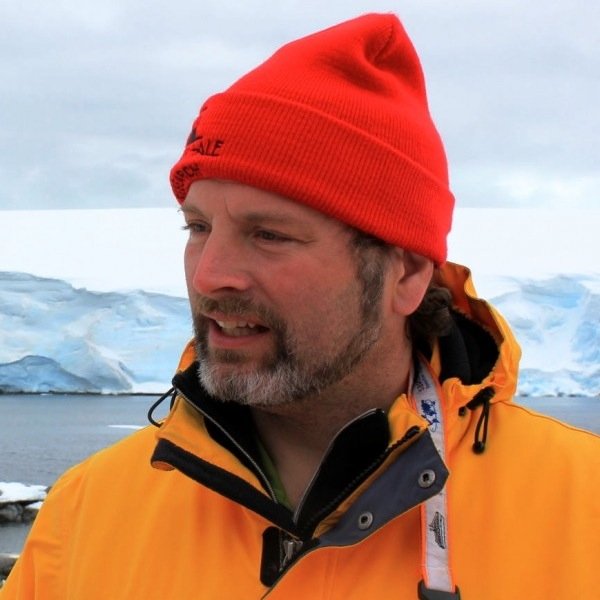
Director of Allied Whale
ABOUT
In 2018, Sean completed a project with the Great Courses™. Entitled Life in the Worlds Oceans, this educational series—entirely authored and presented by Sean and in partnership with the Smithsonian Institution—won a Telly award in 2019.
When not obsessed with all things COA and polar, Sean is an avid photographer, luthier, woodworker and guitarist!
Before COA
Sean grew up on the outskirts of London, England, son to parents heavily involved in the music industry. Many of Sean’s first babysitters were sound engineers— whenever he accompanied his father on a gig into London. He is a graduate of Whitgift High School, where he learned to love rugby and mountaineering/rock climbing. Sean did his undergraduate degree at the University College of North Wales, where he also expanded his experience as an leader in climbing and hiking expeditionS, and where he also qualified as a Lead Dive Instructor in SCUBA under the British Sub Aqua Club.
Sean then turned to Newfoundland, Canada, for his graduate degrees at Memorial University of Newfoundland under Dr. Jon Lien, one of the most respected whale scientists in Canada. Under Jon’s mentorship Sean learned the importance of engaging all stakeholders in conservation management, and that science was not the be-all end-all way of knowing. These experiences were the perfect pre-adaptation for his career at College of the Atlantic, working as a transdisciplinary human ecologist.
Course Areas
Marine mammalogy, biology, oceanography, statistics
COURSES
EDUCATION
- Ph.D. Biopsychology, Memorial University, 1998
- M.Sc. Memorial University, St. John’s, Newfoundland
- B.Sc. University College of North Wales, UK
INTERESTS
Sean came to College of the Atlantic in 1998 and serves as part of the marine science faculty; he believes strongly in placing students in the field environment to provide the best possible experiential education. This includes numerous field trips on the ocean and visits to the Colleges offshore islands.
As a researcher, Sean is involved in several projects as a principal investigator. Studies include: photo-identification and biopsy of finback and humpback whales, working at sites that vary from the remote field site of Mount Desert Rock, located 25 miles offshore in the Gulf of Maine, to the Antarctic Peninsula; bioacoustic assessments of whale-shipstrike interactions; passive acoustic monitoring; and examinations of baleen whale and pinniped foraging ecology using stable isotopes. He directs Allied Whale, as well as the Marine Mammal Stranding Response Program at College of the Atlantic.
Much of Sean’s background is in the field of fishery-marine mammal interactions. He spent 10 years in Newfoundland as part of the Whale Disentanglement team, a group that releases large entangled whales from fishing gear. In Maine he is trained as part of a first response team that performs a similar function, coordinated by the Center for Coastal Studies, and regularly consults with the federal and state governments on disentanglement activities. He has worked on several projects that successfully designed alarms for fishing gear that reduce marine mammal entanglements.
In Maine he works principally in the field of foraging ecology, using stable isotope science to understand the shifting diet of whales under the selective pressure of a rapidly changing oceanographic environment. Within Sean’s near 30-year tenure at the college, the Gulf of Maine has increased in temperature over 4°F, a massive swing within the context of biological oceanography.
Sean started work as wildlife guide in 1995, escorting groups such as BBC: Blue Planet and Scientific American Frontiers to find whales to film. Towards the end of his graduate career at Memorial he was leading trips for tourists to subpolar destinations such as southern Labrador to find wildlife. Since coming to COA, he has extended his field of operations to the Antarctic Peninsula, the Canadian High Arctic, Greenland, Norway, Svalbard, Iceland, and Alaska as well as warmer climes such as the Gulf of California and the Kimberly coastline of the Northern Territories of Australia.
He has held polar guide certification for over 25 years, and has 22 seasons-worth of experience working in the Arctic and Antarctica. He also holds a USCG Master certification for vessels up to 25 tons in nears coastal environments, as well as a Royal Yachtsman Association Power Boat II certificate, and a Wilderness First Responder certificate. He has worked for a variety of expedition tourism companies, including Abercrombie and Kent, Hapag Lloyd, Ponant and Silver Seas, but for the past 13 years has worked exclusively for Seabourn, and was part of the inaugural team that created one of the first luxury expedition products for Antarctica; he also assisted in the launch of two new purpose-built expedition vessels, MS Venture and MS Pursuit. Aboard these vessels Sean has instigated a citizen science project that encourages guests to submit images of whale tails to the catalogs that Allied Whale curates.
Many of Sean’s travels and encounters with wildlife have been recorded through his camera; photography is a hobby he has retained since his teens. As a scientist, his camera remains an essential part of his research equipment.
ADVOCACY
Sean serves on the Scientific Advisory Board for The Shaw Institute, and is a member of the board for the Ellsworth Community Music Institute. He is also a member of the Maine Coalition for the North Atlantic Right Whale
PUBLICATIONS
Allen, K., Petersen, M. L., George V. Sharrard, G. V., Wright, D., and Todd, S. K. 2012. Radiated noise from commercial ships in the Gulf of Maine: Implications for whale/vessel collisions. Journal of the Acoustical Society of America, 132(3) EL229-EL235.
Bort, J., Van Parijs, S., Stevick, P., Summers, E., and Todd, S. K. 2015. North Atlantic right whale (Eubalaena glacialis) vocalization patterns in the central Gulf of Maine from October 2009 to October 2010. Endangered Species Research 26:271-280.
Davis, G., Baumgartner, M. F., Bonnell, J. M., Bell, J., Berchok, C., Bort-Thornton, J., Brault, S., Buchanan, G., Charif, R. A., Cholewiak, D., Clark, C., Corkeron, P., Delarue, J., Dudzinski, K., Hatch, L., Hildebrand, J. A., Hodge, L., Klinck, H., Kraus, S., Martin, B., Mellinger, D., Moors-Murphy, H., Nieukirk, S., Nowacek, D., Parks, S., Read, A., Rice, A. N., Risch, D., Sirovic, A., Soldevilla, M., Stafford, K., Stanistreet, J., Summers, E., Todd, S. K., Warde, A., and van Parijs, S. 2017. Long-term passive acoustic recordings track the changing distribution of North Atlantic right whales (Eubalaena glacialis) from 2004 to 2014. Nature Scientific Reports 7: 13460.
Davis, G. E., Baumgartner, M. F., Corkeron, P. J., Bell, J., Berchok, C., Bonnell, J. M., Bort Thornton, J., Brault, S., Buchanan, G. A., Cholewiak, D. M., Clark, C. W., Delarue, J., Hatch, L.T., Klinck, H., Kraus, S.D., Martin, B., Mellinger, D. K., Moors-Murphy, H., Nieukirk, S., Nowacek, D. P., Parks, S. E., Parry, D., Pegg, N., Read, A. J., Rice, A. N., Risch, D., Scott, A., Soldevilla, M. S., Stafford, K. M., Stanistreet, J. E., Summers, E., Todd, S. K., and Van Parijs, S.M. 2020. Exploring movement patterns and changing distributions of baleen whales in the western North Atlantic using a decade of passive acoustic data. Global Changes in Biology 26(9):4812–40. doi: 10.1111/gcb.15191.
Delarue, J., Todd, S. K., Van Parijs, S. M. and Di Iorio, L. 2009. Geographic variation in Northwest Atlantic fin whale songs: implications for stock structure assessment. Journal of the Acoustical Society of America, 125(3):1774-1782.
Handel, S., Todd, S. K., and Zoidis, A. 2009. Rhythmic structure in humpback whale (Megaptera novaeangliae) songs: Preliminary implications for song production and perception. Journal of the Acoustical Society of America, 125(6): EL225-EL230.
Handel, S. K., Todd, S., Zoidis, A. 2012. Hierarchical and rhythmic organization in the songs of humpback whales (Megaptera novaeangliae). Bioacoustics 21(2):141-156.
Haverkamp, H., Chang, H.Y., Newcomb, E., Doughty, L., Walk, D., Seton, R., Jones, L., Todd, S., and Cammen, K. (in press). A retrospective socio-ecological analysis of seal strandings in the Gulf of Maine. Marine Mammal Science 1– 19. https://doi.org/10.1111/mms.12975
Hill, A. N., Karniski, C., Robbins, J., Pitchford, T., Todd, S. K., and Asmutis-Silvia, R. 2017. Vessel collision injuries on live humpback whales, Megaptera novaeangliae, in the southern Gulf of Maine. Marine Mammal Science 33(2):1748-7692.
Jones, L. S., Stephenson, T. A., Zoidis, A. M., & Todd, S. K. 2022. Drone Observations of a Mother–Calf Humpback Whale (Megaptera novaeangliae) Pair Synchronous Feeding in the Bay of Fundy, Canada. Aquatic Mammals, 48(6), 716-719.
Lien, J., Barney, W., Todd, S. K., Seton, R., and Guzzwell, J. 1992. The effects of adding sounds to codtraps on the probability of collisions by humpback whales. In Marine Mammal Sensory Systems. Edited by Thomas, J.A., Kastelein, R.A., and Supin, A.Y. Plenum Press, New York. pp. 701-708. Invited chapter.
Lien, J., Todd, S. K., and Guigné, J.Y. 1991. Inferences about perception in large cetaceans, especially humpback whales, from incidental catches in fixed fishing gear, enhancement of nets by “alarm” devices, and the acoustics of fishing gear. In Sensory Abilities in Cetaceans; Laboratory and Field Evidence. Edited by Thomas, J., and Kastelein, R. Plenum, New York. pp. 347-362. Invited chapter.
Lubansky, T., Jones, L., Stephenson, T., Taylor, J., Todd, S. K., and Mashintonio, A. In press. Long-term opportunistic sightings reveal shifting optimal habitat locations for humpback whales (Megaptera novaeangliae) in the Gulf of Maine. Marine Mammal Science.
Maloney, M., Todd, S. K. Dendanto, D. and Davis, M. M. 2025. First Documentation of Predation on a Porbeagle Shark (Lamna nasus) by a Gray Seal (Halichoerus grypus). Northeast Naturalist 32(2): N5-N11.
McCordic, J. A., Todd, S. K., and Stevick, P. T. 2013. Differential rates of killer whale attacks on humpback whales in the North Atlantic as determined by scarification. Journal of the Marine Biological Association of the United Kingdom 94(5): 1311-1315.
Mullen, K. A., Petersen, M. L., and Todd, S. K. 2013. Has designating and protecting critical habitat had an impact on endangered North Atlantic right whale ship strike mortality? Journal of Marine Policy 42:293-304.
Napoli, C., Hirtle, N., Stepanuk, J., Christiansen, F., Heywood, E., Grove, T., Stoller, A., Dodds, F., Glarou, M., Rasmussen, M., Lonati, G., Davies, K., Videsen, S., Simon, M., Boye, T., Zoidis, A., Todd, S. and L. Thorne. (in press). Drone-based photogrammetry reveals differences in humpback whale body condition and mass across North Atlantic foraging grounds. Frontiers in Marine Science.
Newcomb, E., Walk, D., Haverkamp, H., Doughty, L., Todd, S. K., Seton, R., Jones, L., and Cammen, K. 2021. Breaking down “harassment” to characterize trends in human interaction cases in Maine’s pinnipeds. Conservation Science and Practice 3(11):1-13.
Todd, S., Allen, K., Mahaffey, C., Damon, J., Peterson, M., Hamilton, P. and Kenney, R. 2009. An acoustic mysticete shipstrike mortality risk assessment for the Gulf of Maine. Proceedings of the Institute of Acoustics 2009.
Todd, S., Lien, J., and Verhulst, A. 1992. Orientation of humpback (Megaptera novaeangliae) and minke (Balaenoptera acutorostrata) whales to acoustic alarm devices designed to reduce entrapment in fishing gear. In Marine Mammal Sensory Systems. Edited by Thomas, J.A., Kastelein, R.A., and Supin, A.Y. Plenum Press, New York. pp. 727-739. Invited chapter.
Todd, S. K., Ostrom, P., Lien, J., and Abrajano, J. 1997. Use of biopsy samples of humpback whale (Megaptera novaeangliae) skin for stable isotope (d13C) determination. Journal of Northwest Atlantic Fisheries Science 22:71-76.
Todd, S., and Nelson, D.L. 1994. A review of modifications to the webbing and setting strategies of passive fishing gear to reduce incidental by-catch of cetaceans. In Annex F of Gillnets and Cetaceans. IWC Spec. Pub. 15. Edited by Donovan, G., Perrin, W.F., and Barlow, J. IWC, Cambridge. pp. 67-69.
Todd, S., Robbins, J., Weinrich, M.T., Pastor, N., Dendanto, D., Palsbøll, P. and A.M. Zoidis (2025). Examination of Isotopic Signals to Determine Trophic Dynamics and Diet of Gulf of Maine Mysticetes prior to an Oceanographic Regime Shift. Aquatic Mammals 51(1).
Todd, S., Rosen, D.A.S., Tollit, D. and Holm, B. 2010. Stable isotope signal homogeneity and differences between and within pinniped muscle and skin. Marine Mammal Science 26(1):176-185.
Todd, S., Stevick, P., Lien, J., Marques, F., and Ketten, D. 1996. Behavioural effects of exposure to underwater explosions in humpback whales (Megaptera novaeangliae). Canadian Journal of Zoology 74:1661-1672.
ABOUT
Course Areas
Botany, plant taxonomy
EDUCATION
- MS, Botany, University of Maine, 1987
- BA, Botany, University of Northern Colorado, 1984
HONORS & AWARDS
PUBLICATIONS
- 2013 Arsenault, M, GH Mittelhauser, D Cameron, AC Dibble, A Haines, SC Rooney and JE Weber. Sedges of Maine: A Field Guide to the Cyperaceae. University of Maine Press, Orono, ME. 712 pp.
- 2010 Mittelhauser, GH, LL Gregory, SC Rooney and JE Weber. Plants of Acadia National Park, Maine. University of Maine Press, Orono, ME. 530 pp.
- 2008 Mittelhauser, GH, SC Rooney, JE Weber, B Nichols. October 2008. Inventory, monitoring and control of invasive plants on Maine Coastal Islands National Wildlife Refuge, Maine Natural History Observatory, Gouldsboro, ME
- 2008 Mittelhauser, G, JE Weber, SC Rooney, B Southard. October 2008. Natural Resource Assessment of the Western Head and Eastern Knubble Preserves, Washington County, Maine
- 2007 Weber, JE and SC Rooney. December 2007. Management Plans For Invasive Plant Species of Acadia National Park. Natural Resources Report NPS/NER/NRR–2007/018. National Park Service. Boston, MA.
- 2005 Greene, CW, LL Gregory, GH Mittelhauser, SC Rooney and JE Weber. Vascular Flora of the Acadia National Park Region, Maine. Rhodora Vol.107, No. 930, Spring, 2005
- 2005 Mittelhauser, Glen, Sally Rooney and Jill Weber. The Vascular Flora of Petit Manan National Wildlife Refuge, Egg Rock, Frenchman Bay, Maine. Maine Natural History Observatory, Gouldsboro, ME
- 2005 Weber, JE, SC Rooney, and G Mittelhauser. Rare Plant Monitoring at Petit Manan National Wildlife Refuge. Natural History Observatory, Gouldsboro, ME.
- 2005 Weber, JE and SC Rooney. Efficacy of Utilizing Volunteers to Conduct Rare Plant Monitoring in Acadia National Park. Natural Resources Report NPS/NER/NRR—2005/003.
- 2004 Greene, CW, JE Weber, SC Rooney and KD Anderson. Invasive Plant Species Distribution and Abundance in Acadia National Park. Tech. Report NPS/NER/NRTR—2004/003.
- 2002 Greene, CW, JE Weber and SC Rooney. Rare Plant Monitoring in Acadia National Park. Tech. Report NPS/BSO-RNR/NRTR/2002-101994 (with S Rooney) Viola canadensis: a new state record for Maine. Maine Naturalist 2(1):
45-46. - 1993 (with T Eyesteinsson and MS Greenwood) Management of a prototype indoor orchard for accelerated breeding of larch. Maine Agricultural Experiment Station Misc. Report 377.18 pp.
- 1990 (with KW Hutchison, CD Sherman, SS Smith, PB Singer, and MS Greenwood) Maturation in Larch II. Effects of age on photosynthesis and gene expression in developing foliage. Plant Phys. 94:1308-1315.
- 1989 (with CS Campbell) Breeding system of a hybrid between a sexual and an apomictic species of Amelanchier, shadbush (Rosaceae, Maloideae). Amer. J. Bot. 76:341-347.
Ready to build your own path?
Apply Now
Join a close-knit community built for curiosity, collaboration, and purpose.

connect with admissions
Talk with an admission counselor about your interests, questions, and goals.

Plan a Visit
Attend a class, meet students, and experience learning rooted in place.
Student voices
COA Might be Right for You if…
…you are ready to have your life and identity flipped on its head and dunked in the ocean repeatedly.
Jonna Lynn Nielsen ’27
…you don’t know what you want to study because you have far too many interests to just focus in on one of them.
Wilson Korneev ’28
…you want to be in a small community where people will remember your name.
Alya Kiiashko ’25

…you have an open mind, enjoy small communities, and want a well-rounded (however unconventional) education experience.
Seth Sears ’28
…you want to meet politically, emotionally, and academically engaged people.
Alder Ame ’27
…you think being sent to the oceanside to improve your mental health actually sounds awesome (it totally is).
Carolina de Oliveira Castro ’26
…you are passionate about the natural world and want to study it and love spending time outside.
Conrad Kortemeier ’26
…you want to be surrounded and inspired by people who are excited about niche subjects, and by people who are still figuring out what they’re doing.
Marina Schnell ’25
…you can’t choose between the mountains and the sea.
Megan Maloney ’26
…you want freedom in your class structure.
Andie Piliouras ’26
…you want small, intentional community.
Conlan Lamb ’28

…you want to expand your perspective and knowledge of the world around you, and gain valuable connections from all around the world!
Trinket Lester ’28
…you question the answers to your questions, challenge the status quo, and seek tranquility in the heart of the spruce-fir forests.
Greta Bernier ’27

…you have the desire to choose your own path to a degree.
Béatrice St-Louis ’28